À la carte dining traces its roots to early 19th-century France — and today it’s the dominant menu format in restaurants worldwide. The term describes a dining style where every dish is listed and priced individually, so guests choose and pay for each item on its own rather than committing to a fixed set meal.
For restaurant owners, deciding to offer an à la carte menu is one of the most significant choices you’ll make. It shapes your kitchen operations, your pricing strategy, your service style, and the dining experience your guests walk away with.
This guide covers everything you need to know: what an à la carte menu is, how it works, the different formats it takes, and the real advantages and disadvantages for your restaurant. You’ll also find practical pricing strategies, a step-by-step guide to building one, and a clear way to decide whether this format fits your concept.
An à la carte menu is a menu type where each dish is listed and priced separately, allowing guests to order and pay for individual items rather than selecting a pre-set meal at a fixed price.
The term is French, meaning “according to the card” — the card being the menu itself. According to Wikipedia, the earliest recorded use of “à la carte” dates to 1816, predating the English word “menu,” which only entered common use in the 1830s. The style emerged in France as an alternative to table d’hôte, where guests at an inn or restaurant ate a shared, fixed meal at a common table with limited or no choice. Choosing dishes from one of the many types of restaurant menus available today still begins with understanding what sets à la carte apart.
Three root attributes define every à la carte menu:
Here’s how à la carte compares to the three other main menu formats:
| Feature | À La Carte | Table d’Hôte | Prix Fixe | Buffet |
|---|---|---|---|---|
| Pricing | Per item, individually | Fixed price, set courses | One fixed price, full meal | Fixed price, unlimited self-service |
| Guest choice | Complete freedom | Limited options per course | Limited to moderate | High (self-service) |
| Food preparation | Cooked fresh to order | Prepared in advance | Prepared in advance | Batch prepared |
| Speed of service | Slower | Faster | Faster | Fastest |
| Cost to diner | Variable; can be higher | Predictable, value-focused | Set and predictable | Set, often economical |
| Best for | Fine dining, upscale casual | Hotel dining, group meals | Special occasions | Large groups, events |
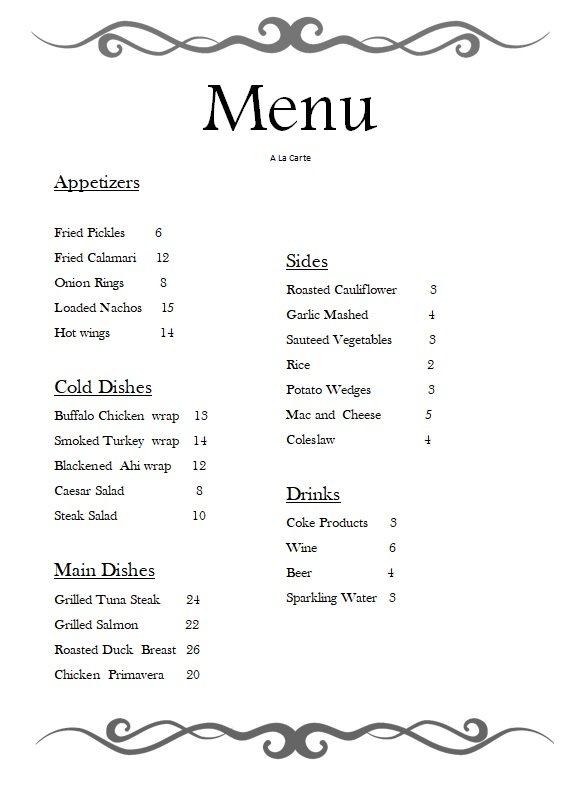
Here’s an A La Carte Sample Menu
Appetizers
Entrees
Sides
Desserts and Beverage
As you can see, each meal is priced separately, and customers are free to choose any combination of foods. The menu includes a variety of meals such as appetizers, entrees, sides, and desserts.
The à la carte service model puts every dining decision in the hands of the guest. Unlike a set menu where courses are predetermined, every item on an à la carte restaurant menu is a separate selection with a separate price. Here’s how the process works from start to finish:
This model gives guests full control but places more demand on kitchen coordination, service staff skill, and timing management than any fixed menu format.
À la carte isn’t a single rigid format — it adapts across different restaurant styles, price points, and service models. Understanding the variations helps you decide which approach fits your concept and your guests.
A full à la carte menu lists every dish — starters, mains, sides, desserts, and drinks — with an individual price for each item. Guests can order in any combination they choose, with no bundled courses or fixed components. This is the classic à la carte format, common in fine dining restaurants, upscale steakhouses, and independent restaurants where individual dish quality is the central appeal. Best for: fine dining and upscale casual restaurants with experienced kitchen teams.
A semi-à la carte menu blends fixed and individual pricing. A main course might come with a choice of two included sides at a set price, while starters, desserts, and drinks are ordered and priced separately. Many casual dining restaurants operate this way — it simplifies kitchen execution and makes food cost management more predictable while still giving guests meaningful flexibility. Best for: casual dining restaurants and family-style concepts.
Hotel restaurants often run a full à la carte menu alongside a buffet-style option. This format serves guests who have specific dietary preferences, who are dining for business, or who want a more personal dining experience than a buffet provides. Hotel à la carte menus often cover a broad range of dishes to cater to diverse guest profiles from different countries and culinary backgrounds. Best for: hotel restaurants and resort dining rooms.
Cafés and bars operate à la carte by default — every coffee, cocktail, pastry, or small plate is individually priced and ordered on its own. The menu may be short, but the structure is fully à la carte: guests order what they want, in whatever quantity they choose, and pay per item. Best for: coffee shops, bars, casual cafés, and snack-focused concepts.
Some restaurants offer a core prix fixe menu at a set price while making certain premium items — a wagyu steak, a tasting menu supplement, or a specialty dessert — available as à la carte additions. This gives restaurants a predictable revenue floor while still allowing guests to spend more on premium selections. Best for: fine dining restaurants running set menus during busy seasons or special occasions.
| Type | Description | Best For |
|---|---|---|
| Full À La Carte | Every item individually priced; complete guest freedom | Fine dining, upscale casual |
| Semi-À La Carte | Mains set-price; starters, desserts, drinks priced separately | Casual dining, family restaurants |
| Hotel/Resort À La Carte | Full individual menu alongside a buffet option | Hotel restaurants, resorts |
| Café/Bar À La Carte | Each drink, snack, or plate priced on its own | Coffee shops, bars, cafés |
| Prix Fixe + À La Carte Supplements | Set menu with premium items available à la carte | Fine dining, seasonal menus |
For the right restaurant concept, an à la carte format is one of the most effective ways to generate revenue and deliver a genuinely personal dining experience.
When guests can choose dishes freely, they get exactly what they want. Someone with a dietary restriction can skip the pasta and order just a salad and grilled salmon. A guest who ate a large lunch can skip the starter and order dessert straight after their main. This level of individual control over the dining experience drives satisfaction and repeat visits — guests feel their preferences are respected rather than ignored.
Individual pricing means you can set prices at a level that reflects each dish’s actual value — a signature dish with premium ingredients can be priced accordingly without making the entire menu feel expensive. Guests also tend to spend more in total when ordering à la carte because each decision feels smaller and more manageable. Adding an extra course or upgrading a side dish is an easy yes when it’s a single, separate choice rather than a bundle commitment.
À la carte service gives your team natural moments to increase restaurant sales through genuine recommendations. A server can suggest a starter to share, recommend a sauce that complements a steak, or mention a dessert worth trying after the main course. These small additions to an order build up significantly across a full service — and they feel like hospitality rather than a sales pitch when done well.
Because items are priced individually, you can add, remove, or adjust dishes without restructuring the entire menu or reprinting everything. A seasonal ingredient comes available — add a new dish this week. A dish isn’t selling — pull it without affecting your other pricing. A supplier price increases — adjust that one item’s price without touching the rest. This flexibility keeps your menu current and lets you respond to what guests are actually ordering.
Every dish on an à la carte menu is prepared when ordered, not hours in advance. That means food comes out at its best — a chef cooking a single portion of lamb to order will consistently deliver better results than one managing a bulk batch for a set menu. This standard of freshness is one of the main draws for high-quality dining guests and a key differentiator against buffet-style concepts where food sits in warming trays.
Running an à la carte format signals to guests that your restaurant prioritizes quality over speed and volume. It positions your concept in the upscale or fine dining tier and attracts guests who are willing to pay more for a high-quality, chef-driven dining experience. For restaurants targeting a discerning clientele, the format itself is part of the appeal.
When each item is ordered and tracked individually, you get clear, dish-level data on what sells and what doesn’t. This makes it straightforward to identify your highest-performing items, spot which dishes to cut, and test new additions without guessing. That kind of insight is much harder to extract from a set menu where guests eat the same predetermined courses.
À la carte isn’t the right fit for every restaurant. Before committing to this format, it’s worth being honest about the operational challenges it creates.
Preparing each dish to order requires more skilled kitchen staff than batch-cooking a set menu. Your team needs to execute many different dishes at the same time to a consistent standard — which means hiring experienced cooks and paying accordingly. Labor cost as a percentage of revenue typically runs 30–35% in full-service à la carte operations. Keeping your menu focused and learning to control food costs at the dish level are the two most effective ways to manage this pressure.
Fresh-to-order preparation takes time. Guests at an à la carte restaurant expect a relaxed, unhurried meal — but that pace can become a problem during peak service when multiple tables need different courses at different stages. Coordinating kitchen output so that everyone at a table receives their dishes together requires strong communication between front and back of house, and it gets harder as the restaurant fills up.
Because demand is unpredictable, you may prep ingredients that go unused. If 40% of your guests typically order the salmon but only 10% order it on a given night, you’re left with waste. Managing this requires tight inventory discipline and careful ordering practices. Keeping your menu to 15–20 focused items — rather than offering a large number of dishes — significantly reduces waste compared to an expansive menu.
A long à la carte menu can overwhelm diners. When presented with too many choices, guests take longer to order, feel less confident in their decisions, and sometimes enjoy the meal less because they wonder whether they ordered the right thing. Research in consumer psychology consistently shows that more options don’t always lead to more satisfaction — a well-curated menu of 15–20 dishes nearly always performs better than one with 50.
Running an à la carte kitchen means managing dozens of different tickets at once, each with a different combination of dishes at different stages of preparation. This places more pressure on your chef and kitchen team than a predetermined set menu does. It requires strong kitchen organization, experienced staff, and clear communication systems — all of which add to operating costs. Starting with a tight, executable menu before expanding helps manage this complexity as your team builds confidence.
Now that you understand the real trade-offs, let’s get into the practical side — how to price your à la carte menu to maximize revenue, how to build one that sells, and how to decide whether this format is the right fit for your restaurant concept.
Pricing is where many à la carte restaurants struggle. Price too high and guests hesitate to order. Price too low and your margins disappear. Here are four approaches that work in practice — and how to use them together.
Start with what each dish costs to make. Add up the ingredient costs, account for your target food cost percentage, and set the price from there. Most restaurants target a food cost of 28–35% of the menu price — meaning if a dish costs $7 in ingredients, your target menu price should be around $20–$25. The formula is simple: Menu Price = Ingredient Cost ÷ Target Food Cost %. If your target is 30% and your ingredient cost is $9, your menu price is $30. You can find a detailed breakdown in our menu pricing guide.
Cost-plus gives you a floor, but the market sets the ceiling. Research restaurants with a similar concept in your area. What are they charging for a comparable steak, salmon dish, or vegetarian entrée? If your cost-plus price for a chicken dish comes out at $28 but every competitor charges $22, you need to either reduce your costs or justify the premium with a meaningful difference in quality or presentation. The goal is pricing that makes sense given what guests in your market expect to pay.
Small changes in how prices appear on the menu can meaningfully affect what guests order. Drop the dollar sign — research in menu psychology consistently shows that removing the “$” symbol reduces the “pain of paying” and increases average spend. Price items at $18 rather than $20 (charm pricing). Avoid right-aligning prices in a column — when prices are stacked in a column, guests scan straight down and anchor on the cheapest option. Scatter them or place them at the end of the description instead.
Once prices are set, menu engineering determines which dishes guests actually choose. Place your highest-margin items at the top and bottom of each section — these positions attract the most attention. Put your most profitable dishes in the upper-right area of the menu (the first area the eye lands on). Use visual emphasis — boxes, bold type, or photography — to draw attention to dishes you most want to sell. These techniques work at every price point and in every restaurant style.
Building an à la carte menu that’s profitable, easy to execute, and enjoyable for guests takes more planning than most restaurant owners expect. Here’s how to do it properly from scratch.
Your menu should reflect your concept and speak directly to the guests you’re cooking for. A fine dining restaurant attracting business diners requires a very different set of dishes, portion sizes, and price points than a casual neighborhood bistro. Before you write a single dish, be specific: who is your guest, what do they want, and how much are they willing to spend per meal? Everything else follows from that clarity.
Choose your dishes by course — starters, mains, sides, and desserts — and resist the temptation to include everything. Keep your menu to 15–20 items total across all courses. That’s enough variety to appeal to a range of preferences without overwhelming guests or overstretching your kitchen. Learning how to create a restaurant menu with the right dish mix is one of the most important operational decisions you’ll make.
Organize your menu into clear sections that match how guests think about ordering: hors d’oeuvres or starters, soups and salads, main courses, sides, desserts, and drinks. Within each section, list dishes in a logical order — typically lighter to richer. Clear organization helps guests navigate quickly, reduces how long your servers spend explaining the menu at every table, and makes the ordering process feel easy rather than taxing.
Each dish description should give the guest enough information to make a confident decision — the key ingredients, the cooking method, and any allergen-relevant information. Keep descriptions to one or two lines. Avoid generic claims like “delicious” or “fresh” — instead, name the specific ingredient or technique that makes the dish worth ordering: “12-hour braised lamb shoulder, preserved lemon, harissa.” Specificity creates appetite and justifies the price.
Apply your pricing approach consistently across the menu. Use cost-plus as the foundation, validate against competitors in your market, and then adjust using psychological pricing where it makes sense. Make sure your pricing reflects your food cost targets at the individual dish level — not just across the menu as a whole. Some dishes will run lower food costs (vegetarian starters), and some will run higher (beef or seafood mains). Balancing these across the full menu keeps overall margins healthy.
The layout of your menu affects how guests order. Use fonts that are readable at table lighting levels. Keep section headings visually distinct from dish names. Don’t cram too many items onto one page. Strong menu design tips and thoughtful layout can increase average spend just by guiding the guest’s eye to the right dishes. Avoiding common menu design mistakes — like information overload or inconsistent formatting — makes the ordering experience feel effortless.
One of the biggest operational headaches with à la carte menus is keeping prices and items up to date. Every time you add a seasonal dish, adjust a price, or mark something as sold out, a printed menu becomes outdated. Getting new menus printed costs $100–$300 per run and takes days to turn around — and the instant you change something, your current menus are wrong again. Online menus eliminate this problem entirely: you update once, and every guest sees the current version immediately.
Menubly is built for exactly this. You can create a fully interactive digital menu for your à la carte restaurant — with individual dish photos, descriptions, and course categories — and update any item in seconds. When a dish sells out at 8pm or you want to test a new price point, it’s done instantly. Guests access your menu by scanning a QR code or following a direct link, and you can also set up commission-free online ordering so guests can place à la carte orders directly without losing 15–30% to a delivery app. Menubly is $9.99/month with a free 30-day trial — no credit card required.
Your first version of the menu won’t be your best. Track which dishes are ordered most, which are rarely chosen, and which generate the strongest margins. Pull items that aren’t performing. Test new dishes in a limited run before committing them permanently. The best à la carte restaurants treat their menus as living documents — updated seasonally and refined based on real order data, not just instinct.
À la carte menus are organized by course, with each item listed and priced on its own. Guests order only what they want from each section. Here’s how a typical à la carte menu breaks down:
There’s no obligation to order from every section. A guest might order just an appetizer and a cocktail, or three main courses split across the table. The freedom to choose is the defining characteristic of the format.
À la carte works well in the right context but isn’t the right choice for every restaurant concept. Here’s a straightforward way to think about it.
An à la carte menu is likely a good fit if:
An à la carte menu is likely not the right fit if:
Whatever format you settle on, managing your menu digitally makes it much easier to test different approaches, adjust items and prices without reprinting costs, and track what guests are actually ordering night to night.
À la carte is a French phrase meaning “according to the card” — or, in practical terms, “from the menu.” In a restaurant context, it means each dish is listed and priced individually, and guests order and pay for specific items rather than a set meal. The term dates to early 19th-century France and first appeared in written records in 1816.
À la carte menus price each dish individually and give guests complete freedom to order any combination they choose. A table d’hôte menu offers a multi-course meal with a limited number of options at each course for a single fixed price. Table d’hôte is faster to execute and more economical for guests, but it offers far less flexibility than à la carte.
A prix fixe menu offers a complete multi-course meal — typically three to five courses — for one fixed price. Guests usually have a small number of choices per course but pay a single amount regardless of what they select. À la carte is the opposite: completely open ordering where every dish adds separately to the bill. Prix fixe is more common on special occasions and in tasting-menu-style dining.
It depends on what a guest orders. Guests who order multiple courses on an à la carte menu will typically spend more than they would on a table d’hôte or prix fixe meal that bundles courses at a set rate. However, a guest who orders just a main course and a drink may spend less than a fixed-menu price. The key difference is that total cost is entirely driven by individual choices rather than a predetermined rate.
A semi à la carte menu is a hybrid format where the main course comes with included sides at a fixed price, while starters, desserts, and drinks are priced and ordered separately. Many casual dining restaurants operate this way — it simplifies kitchen execution and makes food cost management more predictable while still giving guests flexibility on the courses they care most about selecting themselves.
À la carte menus are most common in fine dining restaurants, upscale casual restaurants, independent bistros, steakhouses, seafood restaurants, and hotel dining rooms. Cafés and bars also run à la carte by default — every drink and small plate is individually priced. Buffets, quick-service restaurants, and catering operations typically do not use à la carte service because the format doesn’t suit their volume or structure.
There’s no fixed number of courses — that’s the point. A guest can order just one dish or as many as they like. Most à la carte menus are organized around four to six course categories (starters, soups and salads, mains, sides, desserts, drinks), but guests choose which categories, if any, they order from. The selection is entirely theirs.
Yes — this is common and often a smart business choice. Many restaurants run a set lunch menu or a prix fixe tasting menu alongside a full à la carte dinner menu. Some offer a prix fixe as the primary format with selected à la carte dishes available as premium supplements. Running both formats requires careful kitchen planning but gives restaurants the flexibility to appeal to different guest groups, budgets, and occasions.
A buffet is a self-service format where guests pay a single fixed price and help themselves to as much food as they choose from a shared spread. À la carte is table service where each dish is ordered individually by the guest and prepared fresh in the kitchen. Buffets are faster, more economical per person, and better suited to large groups — à la carte offers higher food quality, more personal service, and a more controlled dining experience.
À la carte is pronounced ah-lah-KART. The phrase is French, and all three words are spoken as a single flowing phrase with the emphasis on the final syllable: “kart.” The accent on the first “à” affects the written spelling but not the English pronunciation — you’ll hear it said identically in both French and English-speaking restaurants.
An à la carte menu gives your restaurant full flexibility — over what you serve, how you price it, and how guests experience their meal. It’s the dominant format in fine dining for good reason: it puts dish quality and personal selection at the center of every visit.
The biggest ongoing challenge is keeping individual prices and items current as your menu evolves. Managing that through printed menus is slow and expensive — going digital makes that process instant and cost-free.
Menubly gives you a fully interactive digital menu with individual dish presentations, instant updates, course categories, and commission-free online ordering — all for $9.99/month. Try Menubly free for 30 days, no credit card required.