France counted 639 Michelin-starred restaurants in 2024, including 30 with three stars — more than any other country. Behind every one of those menus sits a structure that dates back more than a century: the French classical menu, a carefully ordered sequence of courses designed to guide diners from the first bite to the last sip.
Developed by Auguste Escoffier in the late 19th century, this 17-course dining format transformed how restaurants organize and serve food. Each course has a specific purpose — from stimulating the appetite with light hors d’oeuvre to cleansing the palate with sorbet between rich meat courses.
This guide covers the full 17 course French classical menu with descriptions and examples for each course, the history behind this dining tradition, the philosophy of course sequencing, and how modern restaurants adapt the structure for today’s guests. Whether you’re a culinary student, hospitality professional, or restaurant owner building a multi-course restaurant menu, you’ll find everything you need here.
A French classical menu is a formal dining structure consisting of 17 courses served in a specific sequence, where each course builds on the previous one to create a balanced progression of flavors, textures, and richness throughout the meal.
The menu structure moves from light appetizers and soups through fish and meat courses, pauses with a palate-cleansing sorbet at the midpoint, then continues with roasted meats, vegetables, salads, sweets, cheese, fresh fruit, and finally coffee or other beverages. This progression isn’t random — it follows a deliberate philosophy of flavor management that Escoffier codified from earlier French culinary traditions.
Unlike an à la carte menu where diners choose individual dishes, or a table d’hôte menu with a fixed set meal, the French classical menu provides a complete dining experience organized by course type. Today, most restaurants serve condensed versions — 3, 5, 7, or 9 courses — but the original 17-course sequence remains the foundation for formal dining worldwide. Still, the principles of this French menu tradition shape how chefs think about course order and flavor balance at every level of dining.
| Feature | French Classical Menu | À La Carte Menu | Table d’Hôte Menu |
|---|---|---|---|
| Structure | 17 courses in fixed order | Individual dishes, guest chooses | Set meal, limited choices per course |
| Course Sequence | Strictly defined progression | No required order | Typically 3–5 courses |
| Pricing | Single price for full menu | Each dish priced individually | Fixed price for set meal |
| Best For | Formal banquets, special occasions | Casual to fine dining | Prix fixe dinners, hotel dining |
| Modern Use | Adapted to 3–9 course tasting menus | Most common format worldwide | Common in hotels and set-menu restaurants |
The French classical menu didn’t appear overnight. It evolved over two centuries through political upheaval, new cooking methods, and the work of several chefs who each built on their predecessor’s foundations. Understanding this history of the menu helps explain why the 17-course structure exists in its current form.
Before the French Revolution of 1789, professional cooking in France was controlled by trade guilds. Each guild held a monopoly over specific types of food preparation — one guild for roasters, another for pastry makers, another for sauce makers. Chefs worked almost exclusively in aristocratic households, cooking elaborate meals for the nobility. Public dining as we know it didn’t exist.
Meals were served in the style known as service à la française, where all dishes for a course were placed on the table at once and guests served themselves. There was no fixed sequence — food was displayed for visual impact rather than organized by flavor progression.
In the 1760s, a Paris merchant named Boulanger began selling dishes he called “restoratives” — a word that would eventually give us the term “restaurant.” But the real turning point came with the French Revolution in 1789. When the monarchy fell, aristocratic households dissolved, and hundreds of private chefs found themselves out of work.
These chefs opened restaurants in and around Paris, bringing their skills to the public for the first time. The guild system collapsed, freeing cooks to prepare any type of food they wanted. This period created the conditions for a more structured approach to dining.
Marie-Antoine Carême (1784–1833) was the first chef to systematically organize French cooking into a codified body of knowledge. He classified sauces into families (what would later become the “mother sauces”), developed elaborate presentation techniques, and wrote extensively about culinary methods. His work established haute cuisine as a discipline with defined rules and standards.
Carême also introduced the concept of pièces montées — elaborate decorative centerpieces made from sugar, pastry, and marzipan. While visually stunning, these displays prioritized spectacle over the diner’s eating experience. It would take another chef to strip away the excess and focus on the sequence of the meal itself.
Auguste Escoffier (1847–1935), often called the “king of chefs”, transformed French dining by doing two things: he simplified the menu and he organized the kitchen.
Escoffier rejected the confusion of the old service style where guests ordered anything in any sequence. Instead, he carefully selected and matched one or two dishes per course, creating a progression where each dish followed the previous one harmoniously. This became the 17-course French classical menu still referenced today.
He also replaced service à la française with service à la russe, where courses are served one at a time in a specific order. And he created the brigade de cuisine — a kitchen hierarchy modeled on military organization — so that each station (saucier, poissonnier, rôtisseur, pâtissier) could execute its portion of the menu with precision.
His book Le Guide Culinaire, first published in 1903, remains a cornerstone of culinary education. It codified hundreds of recipes, defined the five mother sauces (building on Carême’s work), and established the course sequence that defines formal French dining to this day.
Each course in the French classical menu has a defined role. The sequence moves from light and appetite-stimulating dishes through progressively richer courses, pauses with a palate cleanser, then continues to the heaviest meats before winding down through vegetables, sweets, cheese, and beverages. Here are the components of a menu in the classical French tradition.
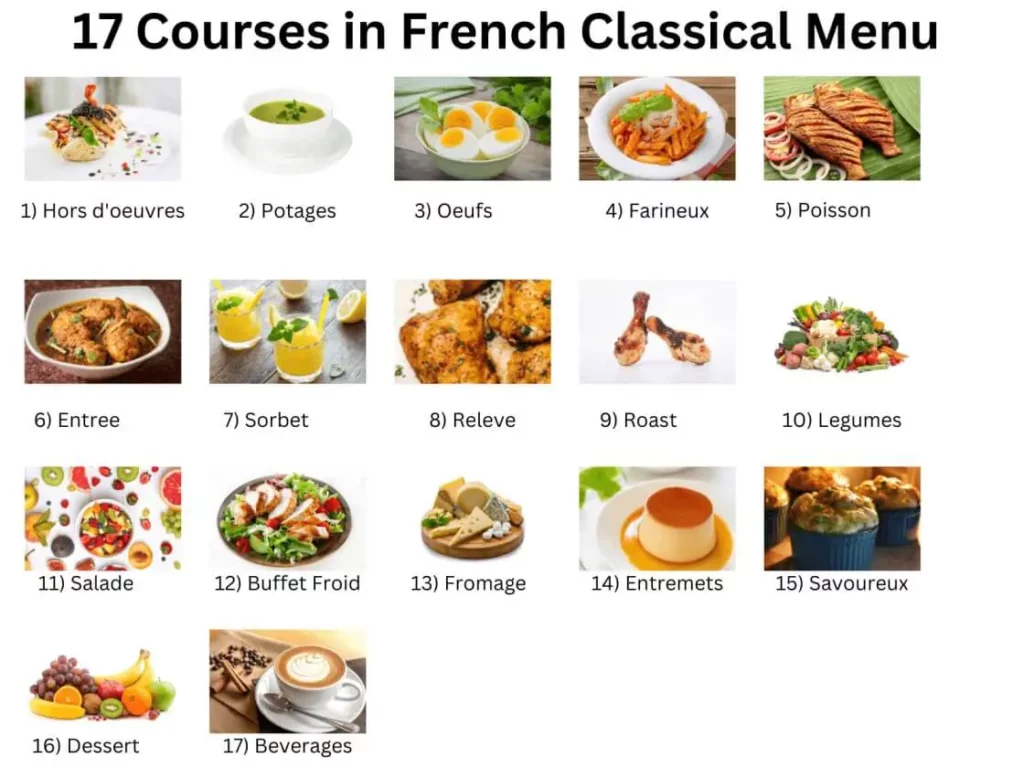
| # | French Name | English Name | Purpose |
|---|---|---|---|
| 1 | Hors-d’oeuvre | Appetizer | Stimulate the appetite |
| 2 | Potage | Soup | Warm the palate |
| 3 | Oeufs | Eggs | Light protein transition |
| 4 | Farineux | Pasta / Rice | Carbohydrate course |
| 5 | Poisson | Fish | Prepare palate for heavier meats |
| 6 | Entrée | First Meat Course | Light meat introduction |
| 7 | Sorbet | Palate Cleanser | Rest and reset between courses |
| 8 | Relevé | Main Meat Course | Primary protein centerpiece |
| 9 | Rôti | Roast | Roasted game or poultry |
| 10 | Légumes | Vegetables | Lighten the palate after meats |
| 11 | Salades | Salad | Refresh and cleanse |
| 12 | Buffet Froid | Cold Buffet | Cold preparations showcase |
| 13 | Entremets | Sweets | Sweet course / desserts |
| 14 | Savoureux | Savoury | Pungent flavors before cheese |
| 15 | Fromage | Cheese | Cheese selection |
| 16 | Dessert | Fresh Fruits / Nuts | Light, fresh finish |
| 17 | Café / Boissons | Beverages | Coffee, tea, digestifs |
The hors d’oeuvre is the first course of the French classical menu. These are small, tangy, salty, or spicy dishes designed to stimulate the appetite for the courses that follow. The word itself means “outside the work” — dishes served before the main body of the meal begins.
Hors d’oeuvre are typically served from a rotating trolley (voiture), with a small amount of each variety placed on the plate to make up a portion. They divide into two categories: general hors d’oeuvre (compound salads, pickled vegetables, cured meats) and classical hors d’oeuvre (more refined preparations like caviar or smoked salmon).
Examples: Caviar, Smoked Salmon, Canapés, Pâté de Foie Gras, Oysters, Shrimp Cocktail
Potage is the soup course, served to warm the palate and provide a smooth transition into the heavier courses ahead. Soups in the French classical menu fall into two main categories: thick soups (cream soups, purées, veloutés) and thin soups (consommés, broths, bouillons).
A well-made consommé — a crystal-clear broth achieved through careful clarification — is considered one of the truest tests of a chef’s skill. The potage course sets the tone for the entire meal and often hints at the flavors that will appear in later courses.
Examples: Consommé Julienne, Crème de Tomate, Potage Parmentier, French Onion Soup, Bisque de Homard
Oeufs are the dishes made from eggs. There are many styles of cooking and preparation of eggs such as boiled, poached, en cocotte, scrambled, and as omelets. This course showcases the chef’s technique with one of the most versatile ingredients in the kitchen.
An important note: this course is not included in the dinner menu. Egg dishes appear only in luncheon menus within the classical structure, since the richness of a full 17-course dinner already provides enough protein through later fish and meat courses.
Examples: Oeufs en Cocotte, Omelette aux Fines Herbes, Oeufs Florentine, Scrambled Eggs with Truffle
The farineux course is Italy’s contribution to the courses of the French classical menu. It includes all forms of pasta, rice, and gnocchi — carbohydrate-rich dishes that add substance before the meal moves into its heavier protein courses.
Common pasta dishes are spaghetti, lasagna, gnocchi, ravioli, and similar preparations, served with sauces that complement rather than overpower. This course bridges the lighter opening dishes and the fish course that follows.
Examples: Spaghetti Napolitaine, Gnocchi Romaine, Risotto Milanese, Lasagna al Forno, Ravioli au Gratin
Poisson are the dishes made from fish and shellfish. Fish, being soft-fibred and delicate, prepares the palate for the heavier meats that follow. The ideal fish for dinner menu compilation are sole, salmon, halibut, and shellfish like lobster and scallops.
Fish preparations in the classical menu typically use gentle cooking methods — poaching, steaming, or light grilling — to preserve the delicate texture. They are served with sauces such as beurre blanc, hollandaise, or velouté. The goal is to introduce protein without overwhelming the palate before the meat courses.
Examples: Sole Meunière, Poached Salmon Hollandaise, Grilled Halibut, Lobster Thermidor, Coquilles Saint-Jacques
The entrée is the first in the meat course sequence. In the French classical menu, “entrée” (also written as entree in English) does not mean main course (as it does in American usage) — it means “entrance” to the meat courses. Meat course entrées are generally small, well garnished dishes which come from the kitchen ready for service.
Entrées are always accompanied by very rich gravy or sauce. When a relevé follows the entrée, potatoes and vegetables are not served with the latter — the entrée stands alone as a composed dish. These preparations are meant to introduce the diner’s appetite to meat without the heaviness of the main course.
Examples: Tournedos Rossini, Chicken Suprême, Lamb Noisettes, Veal Escalope, Beef Stroganoff
Because of the length of the French classical menu, this course is considered to be the rest between courses. The sorbet counteracts the previous dishes and refreshes the appetite for the dishes that are to follow — specifically the heavier main meat course and roast.
A traditional sorbet in this context is water and crushed ice slush flavoured as a rule with champagne and served in a glass, though other liqueurs such as kirsch or calvados may also be used. It is not the fruit-flavored frozen dessert most people think of today. In the classical tradition, Russian and Egyptian cigarettes were passed with the sorbet, giving diners a true pause in the meal.
Examples: Champagne Sorbet, Lemon Sorbet with Vodka, Calvados Sorbet, Kirsch-flavored Ice
The relevé is the main meat course on the menu. Relevés are normally larger than entrées and take the form of butcher’s joints — large cuts that must be carved at the table or in the kitchen before service. This is the most substantial course in the entire meal.
A sauce or a roast gravy with potatoes and green vegetables is always served with this course. The relevé is where the chef demonstrates mastery of roasting, braising, and large-format meat cookery. Each cut is always accompanied by its own particular sauce and garnish.
Examples: Roast Sirloin of Beef, Braised Leg of Lamb, Saddle of Venison, Rack of Veal, Beef Wellington
The rôti is a course that typically comes after the relevé and consists of roast of game or poultry. The roast always features game birds (pheasant, partridge, quail) or poultry (chicken, duck, turkey) served simply to let the quality of the ingredient speak.
A green salad is served separately on a crescent-shaped dish alongside the roast, rather than on the same plate. The rôti is served only with its accompanying salad and its own particular sauce and gravy — no heavy garnishes or side dishes. This simplicity distinguishes it from the more elaborate relevé.
Examples: Roast Pheasant, Roast Duck à l’Orange, Roast Quail, Roast Partridge, Roast Guinea Fowl
Légumes are vegetable dishes that can be served separately as an individual course or may be included along with the entrée, relevé, or roast courses. When served as a standalone course, vegetables take center stage — presented with care and technique rather than as an afterthought.
This course provides a lighter moment after the heaviness of the meat courses, allowing the palate to begin its transition toward the sweeter and lighter courses that close the meal. Preparations range from simple grilled vegetables to elaborate gratins and soufflés.
Examples: Gratin Dauphinois, Grilled Asparagus with Hollandaise, Ratatouille, Baked Stuffed Mushrooms, Cauliflower Mornay
The salad course provides a fresh, crisp counterpoint to the rich courses that preceded it. Salads in the French classical menu are simple green preparations dressed with vinaigrette — not the elaborate composed salads common in modern dining.
The salad course refreshes the palate and aids digestion before the meal moves into its final progression of sweets, cheese, and fruit. Common ingredients include lettuce, watercress, cucumber, tomato, and green pepper, dressed simply with oil and vinegar.
Examples: Salade Française (lettuce, tomato, egg, vinaigrette), Salade Verte, Salade Niçoise, Endive and Walnut Salad
The buffet froid — or cold buffet — is a course of chilled preparations served after the salad. Cold items such as salmon, lobster, terrines, pâtés, and galantines are presented on a platter or trolley for the diner to select from.
This course is gradually returning in popularity after falling out of fashion for decades. It allows the chef to showcase techniques like aspic work, charcuterie, and cold sauce preparation while giving diners a lighter moment before the sweet courses begin.
Examples: Cold Poached Salmon, Lobster Salad, Terrine de Campagne, Galantine of Chicken, Duck Pâté en Croûte
Entremets on a menu refers to the sweet course — what most people today would call dessert. This course could include hot or cold sweets, gateaux, soufflés, ice cream, and elaborate pastry creations. The word originally meant “between courses,” but over time it came to refer specifically to sweet dishes.
One of the most famous entremets is Peach Melba, created by Escoffier himself — vanilla ice cream topped with a peach coated with a raspberry jam sauce flavoured with vanilla and decorated with spun sugar. This course is where the pastry chef (pâtissier) demonstrates their full range of skill.
Examples: Crêpe Suzette, Peach Melba, Soufflé au Chocolat, Bombe Glacée, Tarte Tatin, Profiteroles
The savoureux course returns briefly to savory flavors after the sweetness of the entremets. These are small, pungent dishes — spicy in nature in order to stimulate the appetite and also act as an appetizer for the further courses that close the meal. They are usually served with butter, hot on toast or as a savory soufflé.
The savoureux is an alternative to the outdated practice of serving a second dessert. It provides a sharp, concentrated flavor that prepares the palate for the cheese course. This course is one of the most distinctively British-influenced elements of the French classical menu.
Examples: Welsh Rarebit, Scotch Woodcock, Angels on Horseback, Mushrooms on Toast, Anchovy Canapés
Fromage is the cheese course. All types of cheese may be offered together on a cheese board or served from a rotating trolley. The type of cheese selection varies widely — from soft varieties like Brie and Camembert to hard cheeses like Cheddar cheese, Comté, and Gruyère, to blue varieties like Roquefort.
Cheese is typically served with bread, crackers, butter, and sometimes fruit preserves or fresh fruit. In many French dining traditions, fromage is an alternative to the sweet course rather than an addition — diners choose between cheese and dessert. In the full classical sequence, both are served.
Examples: Brie de Meaux, Camembert, Roquefort, Comté, Époisses, Chèvre
In the French classical menu, “dessert” does not mean the sweet course (that’s the entremets). Dessert is a course of fresh fruit and nuts — forms of fresh fruit presented simply and beautifully, often on a tiered stand or platter. It is a light, natural conclusion before the final beverages.
Fruits and nuts may be served together with a small knife and fork. Nuts are accompanied by salt and a nutcracker. This course signals that the meal is nearing its end and provides a clean, fresh taste after the richness of cheese.
Examples: Fresh Figs, Grapes, Peaches, Oranges, Almonds, Pistachios, Walnuts, Dried Dates
The final course is hot or cold beverages — coffee, tea, herbal infusions, or digestif liqueurs such as brandy, Cognac, or Armagnac. While compiling menus, beverages are not always counted as a formal course, but they are an important part of the dining experience.
In French tradition, coffee is always served after dessert, never with it. A strong espresso or café noir is the standard choice, intended to aid digestion. Petit fours — small pastries, chocolates, or candied fruits — are often served alongside the coffee as a final gesture of hospitality.
Examples: Espresso, Café au Lait, Chamomile Tea, Cognac, Armagnac, Chartreuse, Petit Fours
The 17 courses of the French classical menu aren’t arranged randomly. There are three principles behind the balance of the courses that explain why each dish sits where it does.
1. Light to heavy, then heavy to light. The meal begins with delicate appetizers and soups, builds through fish and light meats, reaches its peak with the relevé and rôti, then gradually returns from heavy to light through vegetables, salad, and fruit. This arc prevents diners from feeling overwhelmed early or leaving unsatisfied at the end.
2. Palate management through contrast. Each course is designed to counteract the previous dishes and prepare the palate for what comes next. Fish prepares the palate for the heavier meats. Sorbet acts as a reset at the midpoint. The savoureux course sharpens the taste buds before cheese. This principle of contrast — sweet after savory, light after rich, cold after hot — keeps each course tasting fresh.
3. Flavor progression tells a story. A well-constructed French classical menu reads like a narrative. It opens with intrigue (hors d’oeuvre), builds tension (soups, fish, first meats), reaches a climax (relevé and rôti), then resolves (vegetables, sweets, cheese, fruit). This understanding of menu psychology — how diners experience flavors over time — is what separates a great multi-course meal from a collection of dishes served in sequence.
These principles are the foundation of menu engineering in any restaurant that offers a tasting or multi-course format. Even a simple 3-course dinner follows the same logic: start light, peak in the middle, finish clean.
Now that you understand what the French classical menu is and the purpose behind each of its 17 courses, let’s look at the practical side — how modern restaurants adapt this structure and how you can create one for your own establishment.
A full 17-course meal takes 3–4 hours and is rarely practical for modern dining. But the global benchmark that French cuisine sets for fine dining means the classical structure still guides how chefs build shorter menus today. Restaurants select courses from the original 17 and arrange them following the same flavor progression principles.
Here’s how the most common modern formats draw from the classical sequence.
The most common format worldwide. A 3-course meal typically includes an appetizer (drawn from the hors d’oeuvre or soup courses), a main course (from the entrée or relevé), and a dessert (from the entremets or fromage). This is the standard for casual fine dining and most prix fixe menu offerings.
A 5-course dinner adds a fish course and a cheese or salad course to the 3-course foundation. A typical sequence: appetizer → soup → fish → main meat → dessert. This format is common in hotel dining rooms and upscale bistros that want to offer a more complete dining experience without the full classical commitment.
The 7-course format includes appetizer → soup → fish → sorbet → main meat → cheese → dessert. Adding the sorbet as a palate cleanser between fish and meat mirrors the original classical structure’s midpoint rest. This is a popular format for special occasions and holiday dinners.
Modern tasting menus at Michelin-starred restaurants typically offer 7–12 courses with small portions. These menus follow the classical progression — light to heavy to light — but feature contemporary techniques, seasonal menus that rotate monthly, and creative interpretations that would have surprised Escoffier himself. The philosophy remains: each course should prepare the diner for the next.
| Format | Typical Courses Included | Best For |
|---|---|---|
| 3-Course | Appetizer, Main, Dessert | Everyday fine dining, prix fixe |
| 5-Course | Appetizer, Soup, Fish, Main, Dessert | Hotel dining, upscale bistros |
| 7-Course | Appetizer, Soup, Fish, Sorbet, Main, Cheese, Dessert | Special occasions, holiday dinners |
| 9+ Course Tasting | Chef’s selection following classical progression | Michelin-starred restaurants, culinary events |
Building a French classical menu — whether a full 17-course experience or a condensed tasting menu — requires careful planning. Here are the key steps to create a restaurant menu rooted in classical French tradition.
Start by deciding how many courses fit your restaurant’s format, service speed, and price point. A full 17-course menu works for once-a-year banquets or culinary showcases. For regular service, 5–9 courses is more practical. Match your course count to your kitchen’s capacity and your guests’ expectations — a food truck doesn’t need seven courses, and a fine dining restaurant shouldn’t limit itself to three.
Whatever your course count, follow the classical light-to-heavy-to-light arc. Start with something that stimulates the appetite — cold, tangy, or briny. Build through fish and lighter proteins before reaching your richest meat dish. Then wind down through vegetables, cheese, or salad before finishing with something sweet and light.
Classical French cooking depends on ingredient quality more than complex technique. A simple poached fish with beurre blanc only works if the fish is fresh. Plan your menu around what’s available in your market each season. This also gives you a natural reason to update your menu regularly — rotating dishes to match seasonal availability.
Avoid repeating the same flavor profiles or cooking methods across courses. If your fish course uses a cream sauce, your meat course should use a gravy or reduction. If your appetizer is cold, your soup should be hot. The goal is variety within the structure — each course should feel like a new experience while still connecting to the overall progression.
Multi-course menus are typically priced as a single package rather than per dish. Research your market and food costs to find the right price point. A 5-course menu at a neighborhood bistro might run $45–$75 per person, while a 9-course tasting at a fine dining restaurant could be $150–$300+. Use a menu pricing strategy that covers your food costs while reflecting the experience you’re providing.
Your front-of-house team needs to understand the purpose of each course — not just what’s on the plate, but why it comes in that order. A server who can explain that the sorbet cleanses the palate before the main meat course adds value to the dining experience. Brief your team on types of service, pacing between courses, and wine pairing logic.
A multi-course French classical menu needs clean, professional presentation that matches the dining experience. Guests should be able to see the full course progression, understand what each course includes, and feel the thought behind the sequence.
Menubly’s menu builder is built for this. You can organize your menu into sections and categories — one for each course — with descriptions, photos, and add-on options. When you change your tasting menu for a new season or a special occasion, updates go live immediately on your online menu. No reprinting, no redesign, no waiting. The result is a digital menu that presents your classical menu with the professionalism it deserves, all for $9.99/month with no technical skills required.
Follow these menu design tips to make sure your digital presentation honors the tradition behind your menu.
A typical French classical menu is a 17-course dining sequence developed by Auguste Escoffier in the late 19th century. It follows a specific order: hors d’oeuvre, potage, oeufs, farineux, poisson, entrée, sorbet, relevé, rôti, légumes, salades, buffet froid, entremets, savoureux, fromage, dessert, and café. Each course has a defined purpose in the overall flavor progression.
The full French classical menu consists of 17 courses. However, the egg course (oeufs) is not included in dinner menus, and beverages are sometimes not counted as a formal course, which is why some sources list 12 or 13 courses. Modern restaurants typically serve condensed versions of 3, 5, 7, or 9 courses drawn from the original 17.
Auguste Escoffier (1847–1935) created the French classical menu structure as we know it today. He built on the work of earlier chefs like Marie-Antoine Carême, but Escoffier was the one who organized the courses into a specific 17-course sequence designed for harmonious flavor progression. He published his system in Le Guide Culinaire in 1903.
The sorbet course is a rest between the lighter early courses and the heavier meat courses that follow. It counteracts the previous dishes and refreshes the appetite. Traditionally, sorbet in this context is water and crushed ice slush flavoured with champagne or another liqueur, served in a glass — not the fruit-based frozen dessert common today.
In French classical dining, “entrée” means the first meat course — literally “entrance” to the meat portion of the meal. Entrées are generally small, well-garnished dishes served with rich gravy or sauce. This differs from American usage, where “entrée” refers to the main course. In the classical sequence, the entrée comes before the larger relevé (main meat course).
The entrée is a small, composed meat dish served ready from the kitchen with rich sauce. The relevé is the main meat course — larger portions in the form of butcher’s joints (roasts, whole cuts) that require carving. Relevés are normally larger than entrées and are always served with potatoes and green vegetables, while entrées stand alone.
The full 17-course format is rarely served outside of culinary schools, historical recreations, and special banquets. But its structure lives on in every modern tasting menu. Michelin-starred restaurants worldwide build their multi-course offerings using the same progression logic — light to heavy, palate cleansers between rich courses, and a winding-down through cheese and sweets. The types of menu used today are all descended from this classical framework.
A French classical menu serves all courses in a predetermined sequence at a fixed price — diners experience the full progression as designed by the chef. An à la carte menu lets diners choose individual dishes, each priced separately, in whatever order they prefer. The classical menu prioritizes the chef’s vision of flavor progression, while à la carte prioritizes the diner’s personal choice.
The French classical menu represents more than two centuries of culinary knowledge — from the guilds of pre-Revolutionary France through Carême’s foundations to Escoffier’s 17-course masterwork. Every modern tasting menu, prix fixe dinner, and multi-course meal traces its roots back to this structure.
Whether you’re serving a full 17-course banquet or a focused 5-course dinner, the classical principles still apply: start light, build toward richness, cleanse the palate at the midpoint, and finish clean. The structure works because it respects how people experience flavor over time.
Ready to present your French classical menu online? Menubly gives you a flexible menu builder with sections and categories for each course, instant updates for seasonal rotations, and professional formatting — all for $9.99/month. Try Menubly free for 30 days, no credit card required.