Running a restaurant is one of the hardest jobs in the food service industry. Margins are thin — most restaurants operate at a 3–5% net profit margin — and the day-to-day tasks come from every direction: high staff turnover, rising food costs, demanding diners, and an endless list of operational demands.
Yet some restaurant owners build profitable, well-regarded businesses that last for decades. The difference almost always comes down to systems and habits. Knowing how to manage a restaurant means building repeatable processes, keeping tight control over costs, delivering consistent customer experiences, and making smart decisions on staffing, menus, and technology.
This guide covers the best restaurant management tips across eight key areas — from hiring staff and controlling restaurant costs to marketing and technology. Whether you’re new to the restaurant business or a seasoned owner looking to tighten restaurant operations, these management tips will help you learn how to run a more profitable, well-organized business.
Restaurant management is the day-to-day oversight of all operations needed to run a food service business. Restaurant management involves everything from scheduling staff and controlling food costs to managing the dining room atmosphere, tracking revenue, and keeping financial records in order.
A restaurant manager’s responsibilities span every part of the business:
The goal of a restaurant manager is to keep all of these areas working together smoothly. Whether you own the restaurant or hold a management position on behalf of an owner, the role requires strong leadership, financial awareness, and the ability to stay calm and make decisions quickly when things go sideways. Essential restaurant management means balancing service and food quality with tight cost control — every single day.
Before you open your doors — or before you take over an existing operation — having a solid restaurant business plan sets the foundation for all the management decisions you’ll make going forward.
Your team is the most important factor in how well your restaurant runs. Great food can be undone by poor service, and a well-run kitchen can’t compensate for a front-of-house that’s disorganized. With the restaurant industry’s staff turnover rate averaging 75–80% annually — costing about $5,864 per lost staff member in recruiting, onboarding, and training — hiring and training staff well is one of the highest-return investments you can make as a manager.
Technical skills like taking orders, running a POS system, or managing reservations can be taught. Attitude, work ethic, and genuine care for customers are much harder to develop in someone who doesn’t already have them. When interviewing candidates, prioritize people who are positive, curious, and willing to learn — especially for front-of-house roles where they’ll interact with diners all day.
Good restaurant managers also know when to delegate. Delegating tasks to capable staff members not only builds their skills and confidence, it frees you to focus on higher-level decisions. Define job duties clearly from the start so every team member understands their responsibilities and what “excellent customer service” looks like in your restaurant.
Don’t rely on informal “shadow a senior employee for a few days” onboarding. Write a structured training process that covers your service standards, food safety requirements, menu knowledge, and POS system operation. New hires should know exactly what’s expected of them from day one — not figure it out over the first few weeks.
For kitchen staff, document prep procedures, portioning standards, allergen protocols, and quality checks. For front-of-house staff, focus on guest greeting scripts, upselling techniques, and how to handle common difficult situations. Consistent training means consistent service, regardless of who’s working. Hands-on experience during training — actually working the line or running tables in a supervised setting — accelerates learning far faster than reading a manual alone.
Overstaffing wastes money. Understaffing leads to poor service and staff burnout, which accelerates turnover. Use your historical sales data to forecast busy and slow periods, then build schedules that match staffing levels to expected demand. Post schedules at least a week in advance so staff members can plan their personal lives — this single habit significantly improves job satisfaction and reduces last-minute callouts.
Creating a positive work environment is one of the most effective retention strategies available to any restaurant manager. The restaurant industry is known for long hours, physically demanding work, and high-pressure service periods — staff who feel respected and supported are far more likely to stay.
Pay competitively, give staff members a clear understanding of their roles and growth paths, and recognize good work in front of the team. Small programs — like an Employee of the Month recognition, shift meal perks, or flexible scheduling — make a real difference. Consider offering mentorship opportunities for ambitious staff who want to move into management roles. Motivate staff not just with compensation but with genuine investment in their development.
Hold brief pre-shift meetings (5–10 minutes) every service to communicate daily specials, sold-out items, operational changes, and team updates. Regular communication keeps your team aligned and reduces costly errors during service.
Food cost is typically 30–35% of a restaurant’s total food and beverage revenue. According to National Restaurant Association data, food and labor together account for roughly 60–70% of total restaurant costs — so managing your restaurant’s finances starts with controlling these two line items. Of all the financial levers available to you, managing food costs is one of the most direct ways to protect your margins.
Your food cost percentage tells you how much of your revenue goes toward ingredients. To calculate it: divide your cost of goods sold (COGS) by total food revenue, then multiply by 100. Most restaurants aim to keep this between 28–35%, depending on the concept. Use a food cost calculator to run these numbers accurately each week.
If your food cost is creeping above target, the usual culprits are over-portioning, spoilage, theft, or supplier price increases that haven’t been reflected in your menu pricing. Learn how to control food costs in your restaurant with a step-by-step approach.
Take inventory at least weekly. Managing inventory by comparing what you ordered, what you sold, and what’s physically on the shelf quickly surfaces waste, discrepancies, and over-ordering. Even a basic spreadsheet works for inventory management — the discipline of counting matters more than the tool you use. Over time, your inventory data also helps you improve ordering accuracy, so you’re not sitting on excess food inventory that risks going to waste.
Food waste is profit thrown in the bin. Train kitchen staff on proper portioning using measured scoops and portion scales. Use FIFO (first in, first out) storage so older stock gets used before newer deliveries. Build daily specials around ingredients that are close to their use-by date. Our full guide on how to reduce food waste in your restaurant covers the most effective tactics in detail.
Build genuine relationships with your key suppliers and negotiate pricing on high-volume items. Buy seasonal produce when possible — it’s typically cheaper and better quality than out-of-season alternatives. Get competing quotes from at least two or three suppliers annually, even if you’re satisfied with your current vendors. This keeps pricing honest and sometimes surfaces better deals you weren’t aware of.
Labor — or payroll costs — is usually the second-largest expense after food, accounting for 25–35% of total sales. In 2024, 64% of restaurant operators reported exceeding their target payroll costs, a problem that directly squeezes already tight profit margins.
A few key practices help keep payroll costs in line:
Use a profit margin calculator to see exactly how payroll cost changes affect your bottom line — and to set realistic targets based on your revenue.
Your menu is both a sales tool and a financial document. The items you offer, how you price them, and how you present them all directly affect profitability. Successful restaurant managers treat the menu as something to be actively managed — not something that gets set once and revisited once a year.
Menu engineering is the practice of analyzing each menu item by its profitability and sales volume, then using that data to make smart placement and promotion decisions. Items that are both popular and profitable are your “Stars” — feature them prominently and protect them. Items that are unpopular and low-margin are “Dogs” — remove them or rework them to improve their economics.
Many restaurant owners underprice dishes to seem competitive, then wonder why profit margins are thin. A sound menu pricing strategy starts with your actual food costs. A common approach is to price dishes at roughly 3x the ingredient cost, targeting a 28–33% food cost percentage per item. If ingredient prices rise, adjust your menu prices — don’t absorb the increase indefinitely.
Monitoring food trends helps you keep your menu fresh and relevant to your target market. Whether it’s plant-based options, globally inspired flavors, or locally sourced ingredients, diners notice when a restaurant’s offerings feel current. Review your menu quarterly and consider introducing limited-time items that tap into trending flavors — this also creates news and conversation around your restaurant.
Outdated menus with wrong prices or sold-out items frustrate customers and create friction during service. If you’re still using printed paper menus, every price change means a full reprint — hundreds of dollars and days of wait time. That delay causes you to either absorb margin losses or disappoint diners who ordered something unavailable.
A digital menu solves this directly. With a digital menu, you can update prices, mark items as sold out, or add seasonal dishes in real time — changes appear the moment you save them. No reprinting, no waiting. You can also generate a QR code that links to your menu, so customers can browse it on their phones without any physical handoff. When you update the menu, the QR code automatically reflects the changes.
An excellent restaurant is defined by consistency — it’s what separates restaurants that build loyal followings from those that rely entirely on one-time visitors. A diner who has a great experience once might come back. A diner who has a great experience every single visit becomes a regular — and regulars are the backbone of any profitable restaurant.
Write down exactly what excellent customer service looks like at your restaurant: how quickly guests should be acknowledged after being seated, how servers should describe specials, how to manage customer expectations during a 20-minute wait. These standards need to be part of your training program so every team member knows what you expect, regardless of who’s working that shift.
Pay attention to the full dining experience — not just the food. The dining room atmosphere, the cleanliness of tableware, the background music, the lighting — all of it shapes how customers feel and whether they’ll return. Great food matters, but a complete, well-managed dining area experience is what earns five-star reviews.
Every restaurant gets complaints. How your team handles them determines whether a frustrated customer becomes a lost customer or a loyal one. Train staff to listen without interrupting, apologize sincerely and specifically, and fix the issue immediately — ideally before the customer has to ask twice. Read our guide on how to handle customer complaints in a restaurant for specific scripts and approaches.
A one-star increase on Yelp is associated with a 5–9% revenue increase. Online customer reviews now shape where most diners choose to eat, so monitoring and responding to them isn’t optional — it’s part of managing your restaurant.
Check Google, Yelp, and TripAdvisor at least weekly and respond to every review — positive and negative. For negative reviews, respond calmly and professionally: acknowledge the issue, explain what you’ve done to address it, and invite the customer back. A well-written response to a negative review often reassures prospective customers far more effectively than a collection of five-star reviews. Learn how to respond to negative reviews without damaging your brand.
For a broader approach to protecting and building your online standing, read our full guide on restaurant reputation management.
One of the most common mistakes new restaurant managers make is trying to hold all day-to-day operations in their heads. Systems — opening and closing checklists, prep procedures, weekly financial review habits, inventory schedules — free up mental space and ensure nothing important gets missed on a busy day. The best managers build systems so the restaurant runs consistently whether they’re on the floor or handling back office work.
Here’s a practical management checklist to build from:
| Frequency | Task | Area |
|---|---|---|
| Daily | Complete opening checklist: cleanliness, equipment function, dining room setup, mise en place | Operations |
| Daily | Review previous day’s sales, food cost, and payroll costs | Finance |
| Daily | Check food inventory levels and confirm prep requirements with kitchen staff | Inventory |
| Daily | Run pre-shift briefing: specials, 86’d items, staffing notes, customer experience priorities | Staff |
| Daily | Be present during peak service periods; step in where support is needed | Operations |
| Daily | Check and respond to online reviews on Google, Yelp, TripAdvisor | Reputation |
| Weekly | Complete full inventory count and calculate shrinkage | Inventory |
| Weekly | Review food cost % and payroll costs % vs. weekly targets | Finance |
| Weekly | Post next week’s staff schedule | Staff |
| Weekly | Analyze menu item sales and food trends: what sold, what didn’t move | Menu |
| Weekly | Inspect all equipment and flag any maintenance issues | Operations |
| Monthly | Review P&L statement and compare to prior months and business goals | Finance |
| Monthly | Conduct informal staff performance check-ins | Staff |
| Monthly | Audit portion sizes and recipe adherence across kitchen staff | Food Cost |
Making restaurant equipment maintenance a weekly habit prevents expensive breakdowns during service — a malfunctioning fryer or walk-in cooler at the wrong moment can cost far more than a regular maintenance check.
Running a restaurant in 2025 without the right restaurant management tools means spending more time on tasks that could be handled faster and more accurately by purpose-built software. The right tech stack doesn’t replace good management — it removes friction from day-to-day operations so you can focus on decisions that actually require your judgment.
Your POS system is the operational hub of your restaurant. Good restaurant management software tracks sales by item, shift, and server; generates labor and revenue reports; manages cash; and integrates with inventory management and accounting software. The data your POS system captures — from sales trends to peak hour information — is the foundation of most management decisions you’ll make each week.
Building schedules manually in spreadsheets wastes time and produces errors. Scheduling management apps let you build shifts based on sales forecasts, track real-time payroll costs against targets, and send schedules directly to staff phones. This alone can reduce no-shows and scheduling miscommunications significantly.
Accounting software that integrates with your POS system automates much of the financial reporting you’d otherwise do manually. Back office management tools handle payroll processing, track vendor invoices, reconcile sales data, and generate the financial reports you need for monthly reviews. For restaurant owners managing multiple locations or complex finances, dedicated restaurant accounting software pays for itself quickly in time saved.
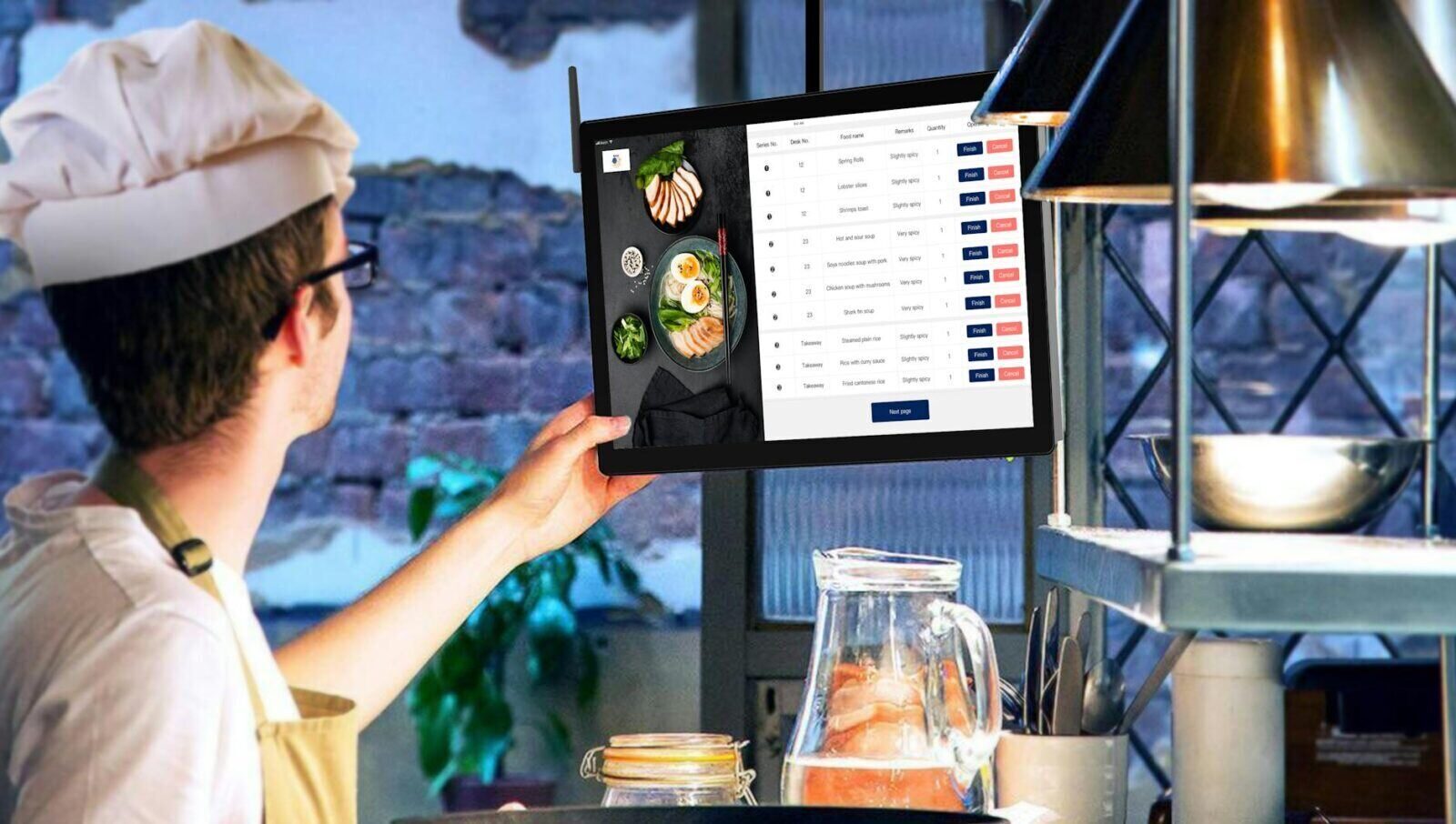
A kitchen display system replaces paper tickets with a digital screen in the kitchen, showing orders in real time as they come in from your POS system or online ordering channel. A kitchen display reduces miscommunication between the dining room and kitchen staff, cuts ticket times, and makes it easier to track order accuracy during busy service periods.
Online ordering is now a standard customer expectation — but routing orders through third-party delivery apps like DoorDash or Uber Eats means paying 15–30% commission on every transaction. On a $10,000 month of delivery revenue, a 20% commission costs $2,000 in profit that goes straight to a third party instead of your business.
Setting up your own direct ordering channel solves this. With Menubly, you can set up online ordering for your restaurant at $9.99/month and keep 100% of every order. Customers order through your own branded menu page, you receive the order directly, and you capture their contact information for future marketing — none of which is possible through third-party apps.
A digital menu that can be updated in real time is a practical operational tool, not just a convenience. With a digital menu, you can change prices instantly, flag items as sold out mid-service, add daily specials without reprinting anything, and share your menu via a QR code or link across all your channels.
Pair it with a simple restaurant website that puts your menu, location, hours, and ordering link in one place — accessible from your Google Business Profile, Instagram bio, or any digital touchpoint where new customers might find you.
Even a well-run restaurant needs a steady stream of new and returning customers. In the restaurant world, marketing is part of restaurant management — not an optional add-on — especially in competitive markets where a new restaurant opens every week.
Start with the basics: claim and fully complete your Google Business Profile, keep your hours and phone number accurate, upload recent photos of your food and space, and add your menu link. A complete Google listing with strong photos is one of the highest-return marketing investments you can make — and it costs nothing except your time. To go further, read our guide on restaurant SEO to help your business rank higher in local search results.
Show up consistently on the platforms where your target market spends time. For most restaurants, that means Instagram and Facebook. Post food photography, behind-the-scenes kitchen content, promotions, and news about new menu items on a regular schedule. Run occasional paid marketing campaigns to reach new customers in your area — even a modest budget of $10–20 per day on Instagram or Facebook can drive meaningful traffic.
Check out our list of restaurant marketing ideas for approaches that work across different restaurant types and budgets.
Acquiring a new customer costs significantly more than bringing back someone who’s already visited. Build a simple loyalty program and collect customer emails through your online ordering system. Send a regular email newsletter with updates, promotions, new menu items, or seasonal specials. Even a monthly newsletter with a limited-time offer generates meaningful repeat revenue from customers who already know and like your food.
For a broader strategic view, read our guide to restaurant marketing strategies covering digital channels, in-restaurant promotions, and reputation-building tactics that work across different restaurant types.
Combining an active digital presence with strong in-restaurant execution is the most reliable path to increase restaurant sales over time.
The most important restaurant management skills are staff leadership, financial literacy, and operational organization. A good restaurant manager needs to motivate staff, communicate clearly under pressure, read financial data like food cost percentages and payroll costs, and keep day-to-day operations running through well-built systems. Problem-solving skills are also essential — the restaurant industry is high-stress, and successful restaurant managers make fast, accurate decisions constantly. Hospitality skills, customer service instincts, and the ability to create a positive work environment round out the picture.
Effective restaurant staff management starts with hiring people who genuinely care about hospitality, then giving them a structured training process so job duties and expectations are clear from day one. Communicate openly, post schedules in advance, recognize good performance publicly, and address problems early before they affect the whole team. Delegating tasks to capable staff members builds their confidence and gives you more time to focus on higher-level management. Brief pre-shift meetings — even 5 minutes — keep everyone aligned on specials, staffing changes, and customer experience priorities for that shift.
A good food cost percentage for most restaurants is between 28% and 35% of total food and beverage revenue. Fast food operations can run lower (25–28%), while fine dining restaurants often run higher (35–38%) because of premium ingredients. Track your food cost percentage weekly by dividing your cost of goods sold by total food sales. If it’s consistently above your target, investigate over-portioning, food waste, theft, or supplier pricing. Read our guide to calculate food cost percentage for the full breakdown.
Full-service restaurants typically achieve net profit margins of 3–5%. Quick-service and fast food restaurants can reach 6–9% because of lower payroll costs and standardized operations. If your margins are consistently below 3%, the most common causes are food cost above 35%, payroll costs above 35%, or both running high at the same time. Review both percentages weekly and use a profit margin calculator to model the impact of small improvements in either area.
Reducing the turnover rate starts with hiring the right fit for your culture, then making staff members feel valued once they’re on the team. Pay competitively, post schedules in advance, recognize good work, and give people a realistic path to grow — including mentorship for those who want to move into management roles. The restaurant industry’s average annual turnover rate is 75–80%, but well-managed restaurants often run at 30–40% or lower. The biggest turnover drivers are poor leadership, unpredictable scheduling, and feeling underappreciated — all things you have direct control over.
On a typical day, a restaurant manager handles opening procedures (equipment checks, dining room setup, food inventory verification), runs a pre-shift briefing with kitchen staff and front-of-house team, monitors service during peak periods, reviews sales and payroll cost data from the previous day, responds to customer reviews, handles operational issues mid-service, and closes out the shift. Beyond daily tasks, managers also handle weekly inventory management, scheduling, financial reporting, and marketing campaigns. The role involves long hours and hands-on involvement in virtually every part of the restaurant business.
A restaurant management system is a set of documented processes for every key function: opening and closing procedures, prep checklists, food inventory counting schedules, financial review routines, and staff training protocols. Start by writing down how the most critical day-to-day tasks should be done, then train your team on those documented processes using your management tools and software. Review and update your systems regularly as you find better approaches. The goal is that your restaurant runs the same way whether or not you’re physically present — that’s what separates a well-managed restaurant from one that depends entirely on one person.
At minimum, a restaurant requires a reliable POS system for sales tracking and payments, scheduling software for managing staff shifts and payroll costs, and a way to track food inventory. Beyond those basics, a kitchen display system, accounting software, a digital menu you can update in real time, a commission-free online ordering system, and a simple restaurant website are increasingly standard in the restaurant industry. The right management tools reduce manual work, give you better data and information to make decisions, and improve productivity across every part of the restaurant — without requiring a large upfront investment.
Managing a restaurant well comes down to building good habits and systems across eight areas: staffing, food costs, payroll costs, menu management, customer experience, day-to-day operations, restaurant management tools, and marketing. No single area can be neglected — weaknesses in one tend to affect all the others. Running a successful restaurant means treating every part of your restaurant operations as connected, because they are.
The best managers in the restaurant industry don’t rely on memory or intuition alone. They document processes, track key numbers weekly, and use software and management tools that reduce time spent on routine tasks — freeing them to focus on leadership, hospitality, and the decisions that drive long-term growth.
For more practical ideas on improving your operation, check out our collection of restaurant improvement ideas that work across different business types and budget levels.
If you’re ready to modernize your menu, take direct customer orders, and cut delivery app commission fees, try Menubly free for 30 days — no credit card required.