OpenTable charges restaurants $1.50 for every diner who books through its network — and with the average restaurant processing hundreds of covers per month, those per-cover fees can add up to $500–$1,000+ monthly on top of the $149–$499 subscription.
OpenTable is still the biggest name in restaurant reservations. But its per-cover pricing model hits small and mid-sized restaurants hard. Between the monthly subscription, per-cover charges ($0.25–$1.50 per seated diner), and a 2% fee on takeout orders, the total cost keeps climbing. Many restaurant owners are realizing they don’t need a massive diner network — they need direct customer relationships and affordable tools they can actually control.
We put together this list of OpenTable alternatives, comparing 10 platforms by pricing, per-cover fees, online ordering, reservation management, and ease of use. Whether you’re looking for a free reservation system, a commission-free ordering platform, or an enterprise-grade guest CRM, there’s an option here for restaurants of all sizes. The restaurant industry is moving away from per-cover pricing — and these alternatives prove it.
Quick picks:
Best for commission-free online ordering: Menubly ($9.99/mo, zero per-order fees)
Best for upscale reservations: Resy ($249/mo, no per-cover fees)
Best for budget reservations: Resos (free tier, plans from $24/mo)
Best for free ordering + reservations: GloriaFood ($0/mo)
What Is OpenTable?
OpenTable is a cloud-based restaurant reservation and table management platform founded in 1998 and acquired by Booking Holdings in 2014. It connects over 60,000 restaurants with millions of diners who use the OpenTable app and website to discover and book tables.
For restaurants, OpenTable provides reservation management, table and floor plan management, guest profiles, waitlist tools, marketing features, and POS integration. For diners, it’s a discovery and booking platform — which is both OpenTable’s biggest strength and the reason many restaurant owners look for alternatives.
The catch? OpenTable’s pricing model charges you for every seated diner. Network bookings (diners who find you through the OpenTable app) cost $1.50 per cover. Reservations through your own website widget cost $0.25–$1.00 per cover on the Basic plan. On top of that, monthly subscriptions range from $149 (Basic) to $499 (Pro), and there’s a 2% service fee on takeout orders for Basic and Core plans. A restaurant with 500 monthly covers on the Basic plan could pay $149 + $750 in cover fees = $899/month before any takeout fees.
OpenTable Features
Online reservation management with confirmation and reminder emails
Table management with customizable floor plans
Guest profiles and customer relationship management (CRM)
Waitlist management for walk-in diners
Marketing tools and email campaigns
Takeout ordering (with 2% service fee on Basic and Core)
POS integration with Toast, Square, Lightspeed, NCR Aloha, and more
Analytics and reporting on covers, revenue, and guest data
OpenTable diner network for restaurant discovery
Direct online booking widget for your website
Pros
Massive consumer network drives new diners to your restaurant
Strong brand recognition — diners trust OpenTable
Reliable table management and floor plan tools
Good POS integration options across major point-of-sale systems
Guest profile data helps personalize the dining experience
Cons
Per-cover fees add up quickly — $500–$1,000+/month for busy restaurants
Network bookings are the most expensive at $1.50 per cover
Monthly subscriptions start at $149 on top of per-cover fees
2% takeout fee on Basic and Core plans
Diners are “OpenTable’s customers” — they may book competitors through the same platform
Limited features on lower pricing tiers
What to Look For in an OpenTable Alternative
Before picking a reservation platform or restaurant management system, here are seven things to consider — especially if OpenTable’s pricing has been eating into your revenue.
Pricing transparency — Look for flat monthly fees without hidden per-cover charges. Calculate total cost including subscription fees, per-cover fees, and payment processing fees. A $49/month platform with no per-cover fees often costs less than a $149/month platform that charges $1.50 per diner.
Per-cover and commission fees — This is the biggest pain point with OpenTable. Many alternatives to OpenTable charge zero per-cover fees, which can save you hundreds of dollars every month. Some platforms charge a small fee per extra reservation instead, so read the fine print.
Online ordering capabilities — Some restaurants need more than reservations. If takeout and delivery drive a big part of your revenue, look for platforms that include commission-free online ordering — not just table bookings.
Guest data ownership — Do you own your customer data, or does the platform? With OpenTable, diners belong to the network. Platforms that let you build direct relationships through your own guest data mean better restaurant marketing and more repeat business.
Ease of setup and use — Small restaurants can’t afford weeks of onboarding. Look for platforms that get you live in minutes or hours, not months. If you need to hire a consultant to set up your booking system, it’s too complicated.
Contract flexibility — Avoid multi-year lock-ins. Month-to-month billing lets you switch if a platform isn’t working for your restaurant. Several alternatives on this list offer no-contract plans.
Integration with existing tools — Check that the platform works with your POS, restaurant website, and Google Business Profile. POS integration is especially important if you want reservation and ordering data in one place. The best reservation software fits into your existing workflow without forcing you to change how your front-of-house operates.
Quick Comparison: OpenTable Alternatives at a Glance
Platform
Best For
Starting Price
Per-Cover Fees
Online Ordering
Contract
Menubly
Commission-free ordering
$9.99/mo
None
Yes (commission-free)
No contract
Resy
Upscale dining
$249/mo
None
No
Annual
Eat App
Mid-range reservations + CRM
$49/mo (annual)
None
No
No contract
Tock
Ticketed experiences
$199/mo
None (2% on prepaid)
Takeout only
No contract
Yelp Guest Manager
Yelp discoverability
~$99/mo
None
No
Contact for terms
SevenRooms
Enterprise guest CRM
Custom pricing
None
Yes
Annual
Tablein
Budget reservations
$49/mo
Per extra booking
No
No contract
Resos
Free/cheap reservations
Free
None
No
No contract
Toast
Full POS + table mgmt
$0/mo (hardware req.)
None
Yes ($75/mo add-on)
2–3 year
GloriaFood
Free ordering + reservations
Free
None
Yes (commission-free)
No contract
10 Best OpenTable Alternatives for Restaurants
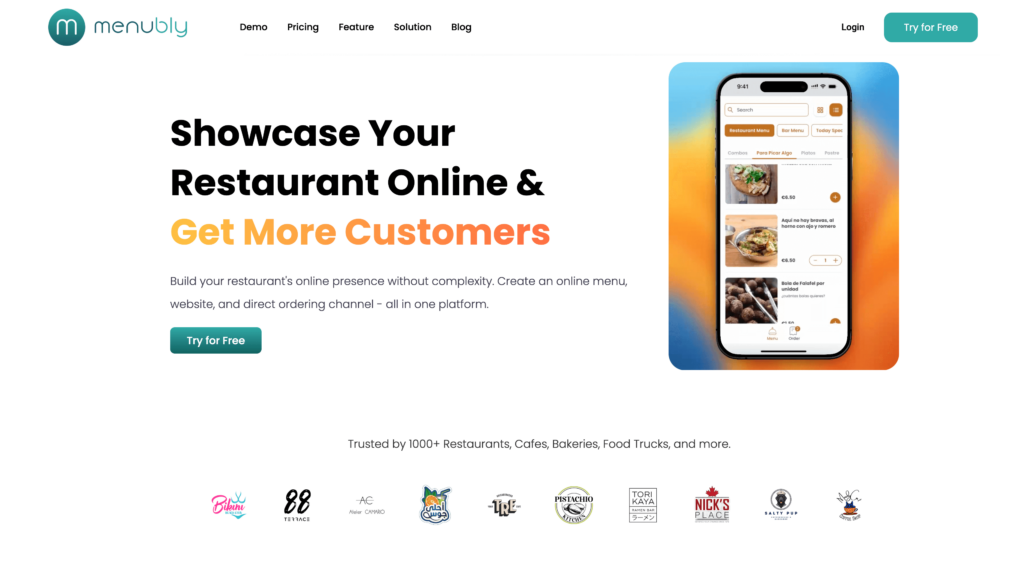
1. Menubly — Best for Commission-Free Online Ordering & Digital Menus
While most OpenTable alternatives focus on reservation management, Menubly solves a related but different problem — helping restaurants capture direct online orders and build their digital presence without per-cover or per-order fees. For many restaurant owners, the real revenue leak isn’t reservation fees. It’s the 15–30% commission that delivery apps like Uber Eats and DoorDash take from every order.
Menubly lets you create an interactive online menu, take commission-free orders for takeout and delivery, and build a simple restaurant website — all for $9.99/month with no per-cover or per-order fees. If your restaurant makes more from online orders than dine-in reservations, Menubly can save you more than switching to another reservation platform.
Key Features
Commission-free online ordering for takeout, delivery, and dine-in — keep 100% of every order
Interactive digital menu with instant updates, photos, and descriptions
Custom plans: Available for businesses with special requirements
Best For
Restaurants, cafes, food trucks, bakeries, and bars that want to take orders directly from customers without paying per-cover reservation fees or 15–30% delivery app commissions. If you’re a small restaurant that needs an affordable digital presence with online ordering, Menubly is the most cost-effective option on this list.
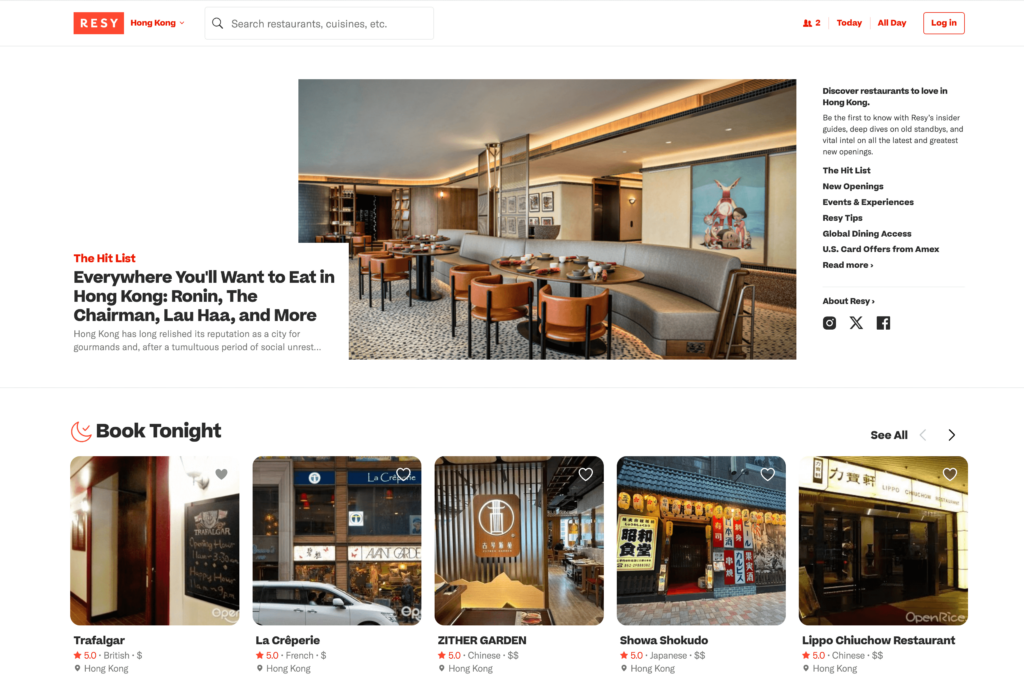
Resy is a cloud-based reservation and restaurant management platform owned by American Express since 2019. It’s known for curating upscale, trendy dining experiences and attracting high-spending Amex cardholders. Unlike OpenTable, Resy charges a flat monthly fee with no per-cover charges — which makes costs predictable regardless of how many diners you seat.
Resy is merging with Tock (also owned by Amex) in summer 2026, which will bring ticketed and prepaid reservation capabilities into the Resy platform. After the merger, Resy will serve around 25,000 establishments. The platform’s main draw is its premium brand positioning and the Amex partnership, which drives high-value diners to your restaurant.
Features
Reservation management with automated confirmations and reminders
Table management with customizable floor plans
Guest profiles and CRM with dining history
Waitlist management system for walk-ins
POS integration with Toast, Square, NCR Aloha, and Micros (bidirectional sync)
ResyOS analytics and reporting dashboard
American Express dining benefits and diner discovery
Marketing tools including email and automated messaging
Ticketed events (via Tock integration, expanding in 2026)
Upscale, trendy, and fine dining establishments that want premium brand positioning, Amex diner traffic, and predictable flat-rate pricing without per-cover fees. If your average check is high enough to justify the $249+/month cost, Resy offers strong value — but casual restaurants looking to save money should look elsewhere.
3. Eat App — Best for Mid-Range Reservation Management + CRM
Eat App is an all-in-one reservation, table management, and guest CRM platform serving 7,000+ restaurants globally. It sits in the mid-range price tier between budget options like Tablein and premium platforms like Resy, offering strong reservation and guest management features without the steep cost of enterprise solutions.
Compared to OpenTable, Eat App charges no per-cover fees on any plan. You pay a flat monthly subscription based on the tier you choose. The platform focuses on helping restaurants build guest profiles, automate communications, and manage reservations across channels including Google Reserve, your website, and social media.
Features
Reservation management with multi-channel online bookings
Table management with visual floor plans
Guest CRM with detailed profiles and visit history
Automated confirmation and reminder SMS messaging
Waitlist management for walk-in diners
Google Reserve integration for direct Google Search bookings
Marketing automation and email campaigns
Reporting and analytics on covers, revenue, and guest data points
Prepayment and deposit collection to reduce no-shows
Online booking widget for your website
Pros
No per-cover fees on any plan — unlike OpenTable’s $0.25–$1.50 per diner
14-day free trial to test the platform
Strong guest CRM and profile features for building customer relationships
Google Reserve integration brings bookings directly from Google Search
Prepayment option helps reduce no-shows
Good mid-range pricing starting at $49/month (annual billing)
Mid-sized restaurants that want reservation management with strong CRM capabilities at a lower cost than Resy or SevenRooms. A good fit for restaurants looking for marketing automation and guest experience tools without paying OpenTable’s per-cover fees.
4. Tock — Best for Ticketed & Prepaid Dining Experiences
Tock is a reservation and ticketed experience platform now owned by American Express. Its standout feature is prepaid reservations — diners pay in advance when they book, which dramatically reduces no-shows. This makes Tock popular with tasting menu restaurants, prix fixe dining, wineries, and experience-based hospitality businesses.
Unlike OpenTable, Tock charges no per-cover fees on its Pro plan. The Plus plan includes a 2% fee on prepaid reservations only. Tock is merging into the Resy platform in summer 2026 — Tock’s consumer-facing website and app will shut down, but its restaurant management software will continue operating as part of Resy.
Features
Reservation management with unlimited covers, users, and mobile devices
Prepaid and ticketed dining experiences to eliminate no-shows
Table management with visual floor plans
Walk-in waitlist tools
Takeout ordering
Event management for special dinners and tasting menus
Guest profiles and CRM
Marketing tools and 2-way SMS communication
Chat feature and email support for quick help
Analytics and reporting
Pros
Prepaid model significantly reduces no-shows — a major pain point for fine dining
No per-cover fees on the Pro plan ($699/month)
Supports ticketed events and tasting menus natively
Unlimited covers on all paid plans
Strong for experience-based dining and hospitality
No long-term contracts required
Cons
Plus plan charges 2% on all prepaid reservations
Pro plan is $699/month — an expensive option for smaller restaurants
Being absorbed into Resy creates uncertainty about Tock’s standalone future
Not designed for casual restaurants or counter service
Limited POS integration compared to Resy
Essential plan is events-only with 2.5% commission + $0.49/booking fee
Fine dining establishments, tasting menu restaurants, wineries, and experience-based venues that want to sell prepaid reservations and reduce no-shows. If you run ticketed events or prix fixe dinners, Tock is purpose-built for your needs — but casual restaurants won’t get enough value to justify the cost.
5. Yelp Guest Manager — Best for Yelp Discoverability & Walk-In Management
Yelp Guest Manager is Yelp’s reservation and waitlist management tool. Its biggest advantage? Direct integration with Yelp’s massive review and discovery platform. If your restaurant already gets traffic from Yelp, Guest Manager turns that visibility into direct Yelp reservation bookings and walk-in waitlist management without per-cover fees.
Unlike OpenTable, which charges per seated diner, Yelp Guest Manager uses a flat monthly subscription. The platform includes table management, guest profiles, automated messaging, and analytics. Yelp also offers an AI-powered phone answering service (Yelp Host) and a kiosk mode for self-check-in — both available as add-ons.
Features
Online reservations directly through Yelp’s consumer network and the Yelp Connect network
Waitlist management system for walk-in diners
Table management with floor plans
Guest profiles with Yelp review history and customer feedback
Automated confirmation and reminder messages
Yelp Host — AI-powered phone answering for reservations
Kiosk mode for self-check-in ($99/month add-on)
POS integration options
Analytics and reporting on covers and guest data
Server management and shift management tools
Pros
Direct Yelp integration drives diner discovery — like OpenTable’s network but through Yelp
No per-cover fees on any plan
Strong waitlist management for busy walk-in restaurants
60-day free trial with $1,800 in Yelp Ads credits
Familiar interface for restaurants already active on Yelp
AI phone answering (Yelp Host) can automate reservation calls
Yelp Host (AI phone): Bundled with Guest Manager from $199/month
Free trial: 60 days + $1,800 Yelp Ads credit
Best For
US restaurants with a strong Yelp presence that want to convert Yelp traffic into direct reservations and manage walk-in waitlists. If Yelp already drives diners to your restaurant, Guest Manager makes it easy to capture those bookings — but restaurants outside the US or without Yelp visibility won’t see the same value.
6. SevenRooms — Best for Enterprise Guest CRM & Data Ownership
SevenRooms is an enterprise-grade hospitality platform that combines reservations, CRM, marketing automation, and guest experience management in one system. It’s used by major restaurant groups, hotels, and multi-location hospitality businesses that need deep guest data across venues.
Unlike OpenTable, SevenRooms uses a commission-free model — no per-cover fees, so restaurants retain more of their profits. The platform’s strength is its CRM: it builds data-rich guest profiles based on visit history, dining preferences, and spending patterns, giving restaurants the tools they need to personalize guest experiences and automate marketing. The trade-off is that pricing is custom and not publicly listed, making it harder to compare directly.
Features
Reservation and waitlist management
Advanced guest CRM with rich profiles across visits and venues
Marketing automation with personalized email campaigns
Online ordering and delivery integration
Event management
Table management with floor plans
POS integration with major point-of-sale systems
Loyalty programs and customer feedback tools
Multi-venue management for restaurant groups
AI-powered features including dynamic pricing and analytics (2026)
Advanced tagging and guest segmentation
Pros
No per-cover fees — commission-free model
Strongest guest CRM in the reservation platform category
Data-rich guest profiles that carry across multiple locations
Strong POS integration ecosystem
AI-powered features for marketing automation and analytics
Multi-location restaurant groups, hotels, and enterprise hospitality businesses that need deep CRM, guest data ownership, and marketing automation across venues. SevenRooms is built for the hospitality industry at scale — if you’re a single-location restaurant, the cost and complexity won’t be worth it.
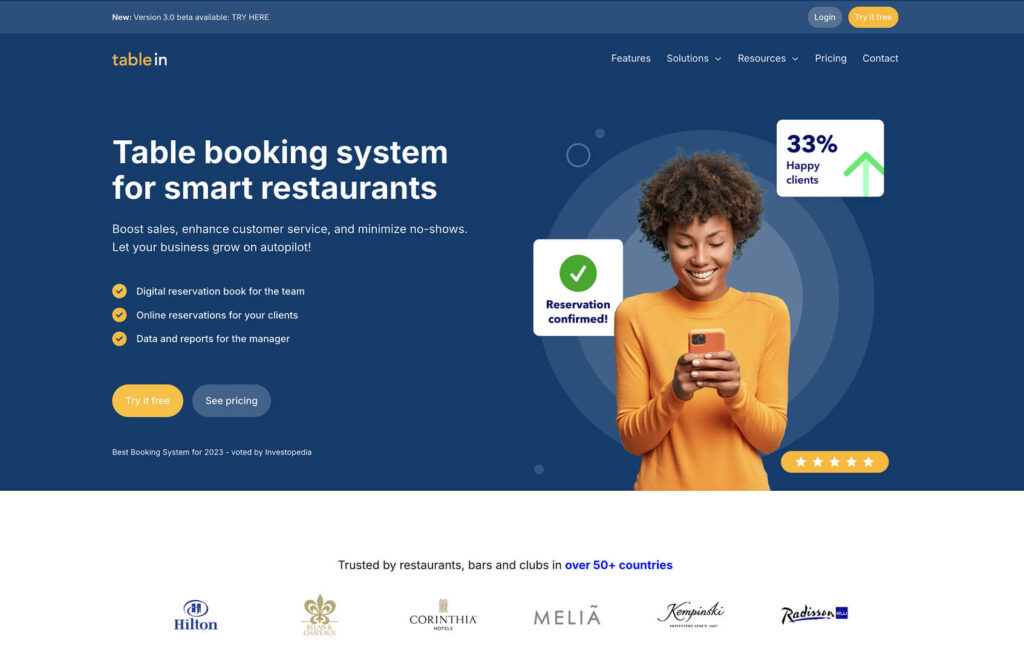
7. Tablein — Best for Budget-Friendly Reservations
Tablein is a simple, affordable online booking system popular in Europe. Unlike platforms like OpenTable or Resy that gate features behind higher pricing tiers, Tablein includes all features on every plan — pricing is based purely on reservation volume. This makes it easy to understand exactly what you’re paying for.
Tablein’s approach is straightforward: pick a plan based on how many reservations you expect per month, and you get the full feature set. No per-cover fees, no feature upsells. For small restaurants that just need a reliable online reservation system without the complexity of enterprise platforms, Tablein delivers the basics well at a price that won’t strain your budget.
Features
Online reservations with a customizable booking widget
Table management with visual floor plans
Automated confirmation and reminder messages
Google Reserve integration for bookings from Google Search
Multi-language support for international diners
Analytics and reporting
Prepayment and deposit option to reduce no-shows
Multi-location management with discounted pricing
Guest profiles and reservation history
Customizable design to match your restaurant’s branding
Pros
All features included on every plan — no feature gating
Small to mid-sized restaurants — especially in Europe — that want a simple, affordable reservation system without enterprise complexity. A good choice for restaurants that want all features from day one and prefer volume-based pricing over per-cover fees.
8. Resos (resOS) — Best for Free & Low-Cost Reservations
Resos is a Danish reservation platform offering something most OpenTable alternatives don’t: a genuinely free tier. The free plan includes up to 25 bookings per month — enough for small restaurants just getting started with online reservations. Paid plans start at $24/month (promotional pricing), with no per-cover fees on any tier.
For restaurants looking for the cheapest way to accept online reservations, Resos is hard to beat. It includes a visual table planner, Google Reserve integration, and no-show management tools. The feature set is smaller than platforms like Eat App or SevenRooms, but for the price, it covers the reservation basics well.
Features
Online reservations with booking widget for your website
Visual table planner showing table status (free, reserved, occupied)
Google Reserve integration for bookings from Google Search and Maps
No-show management with automated fee charging
Prepayment options for deposits
Multi-language support for the booking system and management interface
Drag-and-drop table management
Customizable design for the booking widget
Analytics and reporting
Pros
Free tier with 25 bookings/month — no credit card required
No per-cover fees on any plan
Google Reserve integration on all plans
No contracts — cancel anytime
Free setup and customer support
Promotional pricing available (up to 50% off listed prices)
Cons
Free plan limited to 25 bookings per month
No online ordering for takeout or delivery
Smaller feature set than Eat App or SevenRooms — limited advanced features
Limited POS integration options
Newer and smaller platform with less brand recognition
Small restaurants and cafes that want to start accepting online reservations for free and scale up as booking volume grows. If you’re a small establishment handling fewer than 25 reservations a month, Resos lets you get started without spending a dollar.
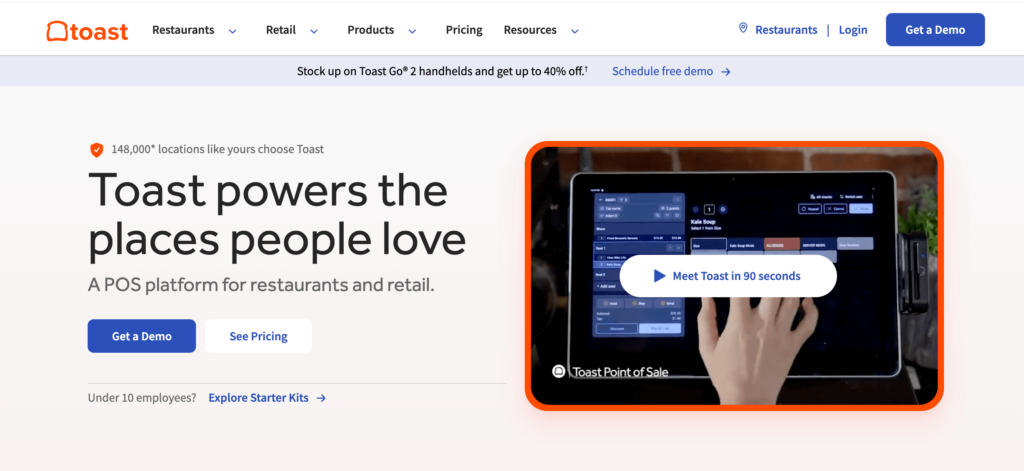
9. Toast — Best for All-in-One POS with Table Management
Toast isn’t a reservation platform like OpenTable — it’s a full-service restaurant POS system with built-in table management, floor plans, and online ordering. For restaurants that want to consolidate their tech stack, Toast replaces both OpenTable and your current POS with a single restaurant management system.
Toast’s Starter plan is $0/month for software, but it requires proprietary hardware ($800–$8,000+) and comes with higher payment processing fees. The platform includes a kitchen display system, employee management, reporting, and third-party delivery integration. Online ordering is a $75/month add-on. The trade-off for Toast’s all-in-one approach is 2–3 year contracts and payment processor lock-in.
Features
Cloud-based POS on proprietary Android hardware
Table management and customizable floor plans
Online ordering with delivery and pickup support ($75/month add-on)
Mid-to-large full-service restaurants that want a single system for POS, table management, online ordering, and staff management — and are willing to commit to proprietary hardware and multi-year contracts. Not the right fit for restaurants looking for just a reservation system or those on tight budgets.
10. GloriaFood — Best for Free Online Ordering with Built-In Reservations
GloriaFood (backed by Oracle since 2021) offers one of the most generous free tiers in restaurant technology. The core online ordering system is completely free — no commissions, no per-order fees, unlimited orders. And unlike most ordering platforms, GloriaFood includes a built-in table reservation system at no extra cost.
For restaurants that need both online ordering and reservations without paying OpenTable’s per-cover fees or delivery app commissions, GloriaFood covers both. The platform includes QR code ordering for dine-in, delivery management, and promotional marketing tools. Paid add-ons start at $9/month for a sales-optimized website and go up to $59/month for a branded mobile app.
Small independent restaurants, ghost kitchens, and food businesses that need both free online ordering and a basic reservation system without any upfront cost. If you want to stop paying OpenTable’s per-cover fees and delivery app commissions at the same time, GloriaFood’s free tier is a strong starting point.
How to Choose the Right OpenTable Alternative
The best alternative depends on your restaurant’s size, budget, and what’s actually costing you the most money. Here’s how to narrow it down.
$200+/month: Resy ($249+/mo), Eat App Pro ($229/mo annual), SevenRooms (custom)
By Restaurant Type
Fine dining / upscale: Resy or SevenRooms
Casual dining: Eat App or Tablein
Fast casual / counter service: Menubly or GloriaFood
Food trucks / takeout-focused: Menubly
Multi-location groups: SevenRooms or Toast
Experience-based / tasting menus: Tock
Yelp-heavy US restaurants: Yelp Guest Manager
By Primary Need
I just need online ordering without fees: Menubly or GloriaFood
I need a reservation system: Eat App, Tablein, or Resos
I need both reservations and ordering: GloriaFood or Toast
I need premium guest CRM: SevenRooms
I need to reduce no-shows with prepaid reservations: Tock
I need a full POS + table management: Toast
For most small to mid-sized restaurants, the biggest cost savings come from eliminating per-cover fees and delivery app commissions — not from finding a slightly cheaper reservation system. If online orders drive more of your revenue than dine-in reservations, a platform like Menubly at $9.99/month can save you more than any reservation-only alternative. And if you need reservations too, pairing Menubly with a free tool like Resos gives you both ordering and bookings for under $35/month total.
Frequently Asked Questions
What is the best free alternative to OpenTable?
For reservations, Resos offers a free tier with 25 bookings per month. For online ordering with built-in reservations, GloriaFood is completely free with unlimited orders and no commissions. Menubly offers a free 30-day trial for commission-free online ordering at $9.99/month after that.
How much does OpenTable really cost per month?
OpenTable’s monthly subscription ranges from $149 to $499, plus per-cover fees of $0.25–$1.50 per seated diner. A restaurant seating 500 covers monthly on the Basic plan could pay $149 + up to $750 in cover fees = $899/month. There’s also a 2% service fee on takeout orders for Basic and Core plans.
Can I accept online reservations without per-cover fees?
Yes. Resy, Eat App, Tablein, Resos, SevenRooms, and Yelp Guest Manager all charge flat monthly fees with no per-cover charges. This is the biggest difference between these alternatives and OpenTable’s pricing model.
Is Resy better than OpenTable?
Resy charges no per-cover fees (flat $249+/month), has an American Express partnership that drives high-spending diners, and is merging with Tock to add ticketed dining. OpenTable has a larger consumer network for diner discovery. Resy is better for upscale restaurants that want predictable costs. OpenTable may still make sense if you rely heavily on its network to fill seats.
What is the cheapest restaurant reservation system?
Resos offers a free tier with 25 bookings per month. After that, Tablein and Eat App both start at $49/month (Eat App with annual billing). GloriaFood includes a basic reservation system for free alongside its ordering platform.
Do I need a reservation system if I’m a small restaurant?
Not always. Many small restaurants, coffee shops, and food trucks benefit more from online ordering than reservations. If takeout and delivery drive more revenue than dine-in bookings, a commission-free ordering platform like Menubly at $9.99/month is a better investment than a reservation system. You can always add a free reservation tool like Resos later if needed.
Can I switch from OpenTable without losing my guest data?
Most alternatives allow guest data import. Eat App and SevenRooms offer migration assistance. Before canceling OpenTable, export your guest list, reservation history, and any notes you’ve built up. The transition is usually straightforward — the bigger challenge is redirecting your regular diners to your new booking system.
What’s happening with the Resy and Tock merger?
American Express is merging Tock into the Resy platform in summer 2026. Tock’s consumer-facing website and app will shut down, but its restaurant management software will continue operating as part of Resy. This means Resy will soon serve around 25,000 establishments and offer both traditional reservations and Tock’s ticketed dining experiences.
Bottom Line
OpenTable built the restaurant reservation industry, but its per-cover pricing model doesn’t work for every restaurant — especially smaller operations where $500–$1,000/month in cover fees eats into already thin margins. The good news: there are now alternatives at every price point.
Here’s a quick recap:
Best for commission-free ordering: Menubly ($9.99/mo)
Best for upscale reservations: Resy ($249/mo)
Best for mid-range reservations: Eat App ($49/mo annual)
Best for ticketed dining: Tock ($199/mo)
Best for free reservations: Resos (free tier)
Best for free ordering + reservations: GloriaFood ($0/mo)
Best for enterprise CRM: SevenRooms (custom pricing)
For restaurants where online ordering drives more revenue than dine-in reservations, the smartest move isn’t switching to another reservation platform — it’s capturing direct orders without commissions. Menubly gives you commission-free online ordering, a digital menu, and a restaurant website for $9.99/month — a fraction of what OpenTable charges before you even count per-cover fees. And you keep 100% of every order.
To provide the best experiences, we use technologies like cookies to store and/or access device information. Consenting to these technologies will allow us to process data such as browsing behavior or unique IDs on this site. Not consenting or withdrawing consent, may adversely affect certain features and functions.
Functional
Always active
The technical storage or access is strictly necessary for the legitimate purpose of enabling the use of a specific service explicitly requested by the subscriber or user, or for the sole purpose of carrying out the transmission of a communication over an electronic communications network.
Preferences
The technical storage or access is necessary for the legitimate purpose of storing preferences that are not requested by the subscriber or user.
Statistics
The technical storage or access that is used exclusively for statistical purposes.The technical storage or access that is used exclusively for anonymous statistical purposes. Without a subpoena, voluntary compliance on the part of your Internet Service Provider, or additional records from a third party, information stored or retrieved for this purpose alone cannot usually be used to identify you.
Marketing
The technical storage or access is required to create user profiles to send advertising, or to track the user on a website or across several websites for similar marketing purposes.