Restaurants that apply menu engineering techniques to their menu format see an average profit increase of 10–15%. But before you can engineer your menu for maximum profitability, you need to pick the right type of menu for your restaurant in the first place.
From à la carte and prix fixe to static, seasonal, and digital formats, the many types of menus available to food businesses today go far beyond a single printed page. Each format shapes how your customers order, how your kitchen operates, and how much profit you keep.
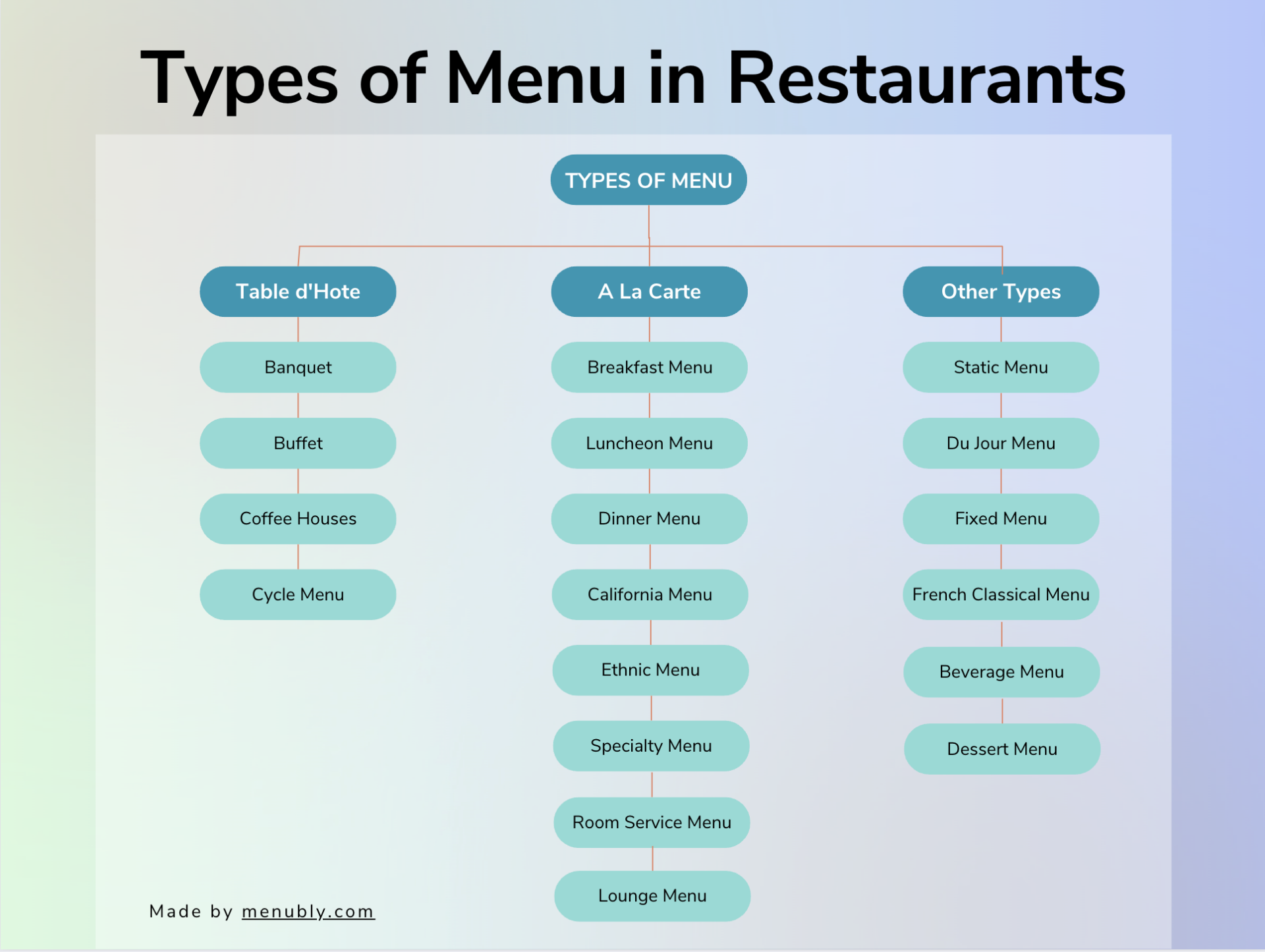
This guide breaks down every major type of restaurant menu — organized by pricing structure, change frequency, and purpose — so you can figure out exactly which ones fit your concept, your customers, and your operations. Whether you’re new to the restaurant industry or refining your current setup, understanding the basic types of menus — and the menu styles within each category — will help you choose the best types of menu for your concept.
A restaurant menu is a document or display that lists all food and drink items available to customers, along with prices, descriptions, and categories. It tells your guests what you serve, how much it costs, and how the meal is organized.
But a menu does more than just list dishes. It showcases your food and drink offerings, sets the tone for the dining experience, guides customers toward your most profitable items, and reflects your brand. A well-thought-out menu can increase average order value, speed up service, and give people a reason to visit your restaurant. To understand more about what a restaurant menu is and why it matters, it helps to start with the basic building blocks: format, pricing, and structure.
The kinds of menus covered in this guide fall into four groups: menus classified by pricing structure, by how often they change, by purpose or occasion, and by format (printed vs. digital). Most restaurants use more than one type at the same time.
The most fundamental way to classify food menus is by how dishes are priced. Some menus let customers pick and pay for each dish individually. Others bundle courses into a fixed price. Your pricing format affects everything from customer expectations to kitchen workflow to average check size. Here are the four main pricing-based menu types.
An à la carte menu allows customers to choose from individually listed and priced dishes, building their own meal course by course. The French term literally means “according to the card.”
This is the most common format in full-service restaurants worldwide. Guests can mix and match according to their preferences — an appetizer and an entrée, just a dessert, or a full multi-course meal. It gives diners maximum flexibility and works well for restaurants with a wide selection of dishes.
Best for: Full-service restaurants, cafes, bars, and any concept where customer choice is a priority.
Key advantage: Higher revenue potential per table through upselling. Servers can suggest add-ons, premium ingredients, and pairings.
Main limitation: Harder to predict food costs and manage inventory, since orders vary widely from table to table.
A table d’hôte menu — also called a set menu — is a multi-course meal offered at a single fixed price, where customers choose one option per course from a limited selection. The French term means “the host’s table” — a reference to the historic practice of innkeepers serving a set meal to all guests at a communal table.
With this format, the restaurant menu sets the price and the course structure, but the diner still picks from 2–3 options per course (for example, a choice of soup or salad, then a choice of two entrées, then dessert). It’s a middle ground between full flexibility and a fully chef-driven experience. You’ll find this format across the globe — from France to India’s thali meals to Japan’s teishoku sets.
Best for: Hotel restaurants, formal dining, cruise lines, and catered events where service consistency and timing matter.
Key advantage: Predictable revenue per cover and simpler kitchen operations, since the menu narrows down ingredient needs.
Main limitation: Less flexibility for guests with dietary restrictions or preferences.
A prix fixe menu is a set-price, multi-course meal where the chef selects every course — unlike table d’hôte, guests don’t choose between dishes. The kitchen decides what’s served, and that’s what you get.
A prix fixe menu is a curated dining experience, typically 3–5 courses, at one all-inclusive price. It’s common for special occasions like Valentine’s Day, New Year’s Eve, and Restaurant Week events. Wine pairings are often available as a separate add-on.
Best for: Fine dining restaurants, chef’s table experiences, holiday dinners, and pop-up events.
Key advantage: Gives the chef full creative control. Kitchen operations are simplified because every table gets the same courses, reducing food waste and prep complexity.
Main limitation: No flexibility for diners. Guests who dislike a course have no alternative, which can feel restrictive.
A tasting menu offers a multi-course dining experience — also called a degustation menu — featuring smaller portions of 5 to 21 dishes, designed to showcase the chef’s full range of skills and flavors.
Courses are served in a deliberate sequence, building from lighter to richer tastes and introducing new flavors with each plate, often with palate cleansers between courses. Wine pairings are a standard add-on. A full tasting menu experience typically takes 2–4 hours and ranges from $75 to $300+ per person at high-end establishments. The format was popularized by chefs like Thomas Keller at The French Laundry and Ferran Adrià at El Bulli.
Best for: Michelin-starred restaurants, chef-driven fine dining, and special occasion venues.
Key advantage: Highest revenue per table of any menu format. Creates a memorable experience that drives word-of-mouth and press coverage.
Main limitation: Long service time, narrow audience appeal, and high labor cost. Not practical for high-turnover or casual restaurants.
| Menu Type | Pricing | Customer Choice | Best For |
|---|---|---|---|
| À La Carte | Each item priced separately | Full freedom | Full-service restaurants, cafes |
| Table d’Hôte | Fixed price per meal | Limited choice per course | Hotels, formal dining, events |
| Prix Fixe | Fixed price per meal | No choice (chef selects) | Fine dining, holidays, pop-ups |
| Tasting Menu | Fixed price (premium) | No choice (chef curates) | Michelin/fine dining |
How frequently your menu changes has a direct impact on your operations, food costs, and the customer experience. Some restaurants keep the same menu for years. Others change it every day. The right approach depends on your concept, your kitchen team, and your ingredient sourcing. Here are the five main frequency-based menu types.
A static menu is a fixed menu that stays the same for extended periods — typically months or even years — offering a consistent selection of dishes every day.
This is the most common menu format across all restaurant segments. From fast food chains to casual dining to neighborhood restaurants, the static menu remains the same day after day, building brand identity through consistency. Customers know what to expect, staff master a set of signature dishes, and inventory control becomes predictable. According to a food production and service textbook, static menus are the best format for forecasting, purchasing, and labor scheduling.
Best for: Fast food, fast casual, chain restaurants, and any business where consistency defines the brand.
Key advantage: Simplified operations across the board — purchasing, prep, training, and cost control are all predictable.
Main limitation: Can feel stale to frequent repeat customers. Doesn’t take advantage of seasonal ingredients or market opportunities.
A cycle menu is a planned rotation of different menus over a set period — typically 1 to 4 weeks — after which the cycle repeats.
This format is standard in institutional foodservice: hospitals, schools, corporate cafeterias, military dining, and senior care facilities. It provides more variety of dishes for captive audiences who eat in the same place every day, while keeping purchasing and preparation efficient. Some restaurants also use weekly rotations for lunch specials or daily set meals.
Best for: Schools, hospitals, corporate dining, senior care, cruise ships, and restaurants with weekly specials.
Key advantage: Once the cycle is planned, daily menu decisions are eliminated. Purchasing can be negotiated in advance for the full rotation.
Main limitation: Repetition can cause “menu fatigue” for diners who eat in the facility daily over long periods.
A du jour menu — French for “of the day” — features dishes that change daily, depending on what’s available at the market or the chef’s creativity that morning.
The most familiar example is “soup du jour.” Du jour menus are usually presented alongside a regular menu as a daily specials section, either announced verbally by the server or written on a board. This format is closely tied to the farm-to-table movement and works well for restaurants that source from local markets.
Best for: Farm-to-table restaurants, upscale casual dining, cafes with rotating pastry selections, and food trucks with ingredient-driven menus.
Key advantage: Signals freshness and creativity. Reduces waste by turning surplus ingredients into daily specials. Gives repeat customers a reason to come back.
Main limitation: Requires daily planning and staff briefings on new dishes. Harder to promote in advance since the menu changes constantly.
A seasonal menu changes 3–4 times per year to highlight ingredients at their peak freshness for each season — spring, summer, fall, and winter.
Seasonal menus may be a standalone format or a rotating section within a static core menu. Restaurants like Seasons 52 have built their entire concept around this approach. Industry research shows that seasonal menus can boost order profits by up to 26%, and seasonal beverage programs increase the average check by 25%.
Best for: Farm-to-table restaurants, fine dining, and any chef-driven concept with strong local sourcing.
Key advantage: Peak-season ingredients taste better and cost less. Seasonal changes create marketing opportunities and drive repeat visits.
Main limitation: Requires reliable supplier relationships and ongoing menu redesign. Reprinting paper menus every season adds cost — unless you use a digital format that updates instantly.
A California menu — also called an all-day menu — is a menu where breakfast, lunch, and dinner items are all available throughout the entire operating day. Guests can order pancakes at midnight or a steak at 7 AM.
Named after California’s relaxed dining culture, this format is most common at 24-hour diners, hotel room service operations, and all-day cafes. Famous examples include Denny’s, IHOP, and classic American diners that serve breakfast all day. Some restaurants take a similar approach with a separate brunch menu on weekends, combining breakfast and lunch items with cocktails.
Best for: 24-hour restaurants, diners, hotel room service, and cafes in areas with shift workers or late-night crowds.
Key advantage: Accommodates guests with irregular schedules and mixed meal preferences at the same table.
Main limitation: The kitchen must stock ingredients for all dayparts at all times, increasing food cost complexity and storage requirements.
| Menu Type | Change Frequency | Best For |
|---|---|---|
| Static | Rarely (months/years) | Fast food, chains, casual dining |
| Cycle | Repeats every 1–4 weeks | Schools, hospitals, corporate dining |
| Du Jour | Daily | Farm-to-table, upscale casual |
| Seasonal | 3–4 times per year | Fine dining, farm-to-table |
| California | Rarely (all dayparts available) | 24-hour diners, hotel room service |
Beyond the core pricing and scheduling formats, most restaurants also use a specialty menu or supplementary format that serves a specific purpose. These menus are often presented alongside or in addition to the main menu — a separate beverage list, a dessert card after the entrée, or a dedicated kids’ menu. You’ll also find specialty menus built around a specific theme, dietary need, or ethnic cuisine. Here are the most common types of menus in this category.
A beverage menu is a separate menu dedicated to drinks — including cocktails, wine, beer, spirits, coffee, and non-alcoholic options — with descriptions and prices for each item.
In bars and cocktail lounges, the beverage menu is the primary menu. In full-service restaurants, a dedicated drinks list directs customer attention to high-margin items like cocktails and wine by the glass. During happy hour, a slimmed-down beverage menu with special pricing can drive traffic during off-peak hours. Rotating the drink menu with the seasons keeps offerings fresh and gives you regular marketing content.
Best for: Bars, cocktail lounges, breweries, fine dining, and any restaurant looking to increase average check through drink sales.
A wine list is a specific type of beverage menu focused entirely on wine, typically organized by varietal, region, and price point. Each entry usually includes the producer, vintage, origin, tasting notes, and suggested food pairings.
A “Wine Captain’s Book” is the extended version — a detailed reference that covers each wine’s history, production method, and flavor profile. Wine is one of the highest-margin items in a restaurant, and a well-curated wine list can be a destination draw on its own. It also supports your menu pricing strategies in upscale settings by anchoring high price points.
Best for: Fine dining, wine bars, steakhouses, and upscale restaurants with a sommelier or trained bartender managing the program.
A dessert menu is a separate menu presented after the main course, listing sweet dishes, signature desserts, coffee, and after-dinner drinks like liquor and cocktails.
Presenting a separate dessert menu at the end of the meal is a proven way to increase revenue. Diners who might ask for the check will often add a dessert or coffee when the options are placed in front of them. Desserts typically carry strong profit margins, making this one of the highest-return supplementary menus you can offer. Adding photos to your dessert menu can increase sales of featured items by up to 30%.
Best for: All full-service restaurants, cafes, bakeries, and any operation with a pastry program or signature desserts.
A children’s menu is a simplified menu with smaller portions, familiar dishes, and lower prices designed for young diners, typically ages 3–12.
A good kids’ menu includes approachable food (chicken tenders, pasta, grilled cheese), combo pricing (entrée + side + drink), and often interactive elements like puzzles or coloring activities. Families actively choose restaurants that offer a dedicated children’s menu — it reduces decision stress for parents and creates a welcoming atmosphere. About 8% of children in the U.S. have a food allergy, so clear allergen labeling on your kids’ menu matters more than you might think.
Best for: Family restaurants, casual dining, cafes, and any restaurant targeting families with young children.
A banquet menu is a menu designed for group events — weddings, corporate dinners, parties — featuring pre-selected dishes served to all guests at a fixed price per person.
Banquet menus are typically non-selective (everyone gets the same meal) or offer limited choices per course. The catering menu is a related format designed for off-premise events, where food is delivered to or prepared at an external venue. Both formats allow for efficient bulk purchasing and preparation, resulting in strong profit margins when priced correctly.
Best for: Hotels with banquet departments, event venues, catering businesses, and restaurants with private dining rooms.
A limited menu focuses on a small selection of dishes — typically 5 to 15 items — allowing the kitchen to specialize and deliver consistently high quality with fewer resources.
This format works when focus is the selling point. Food trucks, ghost kitchens, and single-concept restaurants (burger joints, taco shops, ramen houses) rely on limited menus to keep operations tight and costs low. During high-volume periods or staffing shortages, some restaurants temporarily switch to a limited menu to maintain quality. You can also build a limited menu around specific dietary preferences — like a dedicated gluten-free menu or a plant-based menu — to serve a focused customer segment.
Best for: Food trucks, ghost kitchens, specialty restaurants, pop-ups, and any concept built around doing a few things well.
Now that you know every major type of menu — from how they’re priced to how often they change to what specific purpose they serve — the next question is how to present them. The format you use to display your menu matters just as much as its content. And for a growing number of restaurants, that format is digital.
Every menu type covered above can be presented digitally. Whether you run a static à la carte menu, daily du jour specials, or a separate dessert card, a digital menu lets you update, share, and manage all of them from one place — without printing costs or designer fees. From interactive menus on tablets to QR code menus on smartphones, over 70% of restaurants now use digital menu formats in some form, and 85% use them for menus. Here are the two main digital menu formats.
An online menu is a digital version of your restaurant’s menu hosted on a website or dedicated page, accessible to customers from any device before or during their visit. Taking your restaurant online with a proper menu page is one of the simplest ways to reach more customers.
Online menus serve two important functions. First, they let customers browse and interact with your offerings before arriving — influencing their decision to visit. Second, they enable online ordering for delivery and takeout, expanding your revenue beyond dine-in. A properly set up online menu can also appear in Google search results when someone searches your restaurant name, making your business easier to find.
Unlike a static PDF upload, a true online menu features mobile-friendly design, fast load times, and instant updates whenever you change a price, add a new dish, or mark something as sold out. With Menubly, you can create and manage your online menu in minutes — update any menu type from one dashboard, and changes go live on every device right away. At $9.99/month with zero commission fees on orders, it’s built for food businesses that need to keep menu items current without the cost of reprinting.
A QR code menu is an online menu accessed by scanning a QR code with a smartphone. Customers scan the code at their table, counter, or entrance, and the full menu opens in their phone’s browser — no app download needed.
QR code menus became mainstream during the pandemic as a contactless alternative to shared paper menus, but they’ve stuck around because of the operational benefits. Changes you make to the menu appear instantly on every device that scans the code. You never need to reprint the QR code itself — the code stays the same even when the menu behind it changes. There are real benefits of QR code menus beyond hygiene: cost savings, real-time updates, and the ability to include photos and descriptions that increase average order value.
Main limitation: Requires a smartphone and data or WiFi connection. Older diners or less tech-comfortable guests may prefer a printed option, so many restaurants keep a few physical menus available as a backup.
Most restaurants don’t pick just one menu type — they combine two or three formats that fit their concept. But the starting point is always the same: find the menu type that is ideal for your specific situation. Here are six factors to work through.
The right combination of menu types depends on all six factors together. A farm-to-table restaurant might run a static core menu with seasonal inserts and du jour specials. A hotel might offer à la carte dining in the main restaurant, a prix fixe option for events, room service with a California menu, and a separate wine list for the bar — all managed alongside each other. Good restaurant menu planning means thinking about how these different menus work together, not just what goes on each one.
Yes — and most successful restaurants do. A hybrid menu combines elements from two or more menu types to serve different customer needs and maximize revenue. Here are common combinations that work well:
Managing multiple menu types doesn’t have to be complicated. With a digital menu platform like Menubly, you can create and manage your main menu, daily specials, and a separate drinks menu from one dashboard — updating any of them in seconds without reprinting anything. That kind of flexibility makes it practical to run the hybrid menu setup that actually fits your business, instead of settling for just one format because managing more would be too much work.
A restaurant menu typically includes one or more of these formats: à la carte (items priced separately), table d’hôte (fixed-price multi-course with limited choices), prix fixe (set-price multi-course chosen by the chef), static (unchanging menu), cycle (rotating on a schedule), du jour (daily changing), seasonal, beverage, dessert, children’s, banquet/catering, and limited menus. Digital formats like online menus and QR code menus are also standard in most restaurants today. Most food businesses use a combination of two or more types.
With an à la carte menu, each dish is priced separately and customers order whatever they want individually. With a table d’hôte menu, the meal is a fixed-price multi-course package where customers pick one option per course from a limited selection. À la carte gives full freedom; table d’hôte gives a structured dining experience at a set price.
Both are multi-course, fixed-price meals, but the key difference is choice. A table d’hôte menu lets the customer choose one option per course from a short list. A prix fixe menu is fully set by the chef — guests receive the same courses with no substitutions. Prix fixe is the more rigid format, typically used in fine dining and special events.
A du jour menu (French for “of the day”) features dishes that change daily based on the freshest ingredients available or the chef’s creativity. The most well-known example is “soup du jour.” Du jour menus are usually presented alongside a static menu as daily specials, not as a standalone menu.
A California menu is an all-day menu where breakfast, lunch, and dinner items are all available at any time the restaurant is open. Named after California’s relaxed dining culture, this format is typical at 24-hour diners, hotel room service, and all-day cafes like Denny’s and IHOP.
A static menu is the best foundation for a fast-casual restaurant. It keeps operations consistent, makes staff training straightforward, and allows for bulk ingredient purchasing. Many fast casual businesses add a du jour special or seasonal limited-time offer on top of their static base to keep things fresh without overcomplicating operations.
A static menu stays the same every day for months or years. A cycle menu rotates through different menus on a set schedule (for example, a new menu each day for two weeks, then the cycle repeats). Static menus are most common in commercial restaurants, while cycle menus are standard in institutional settings like schools, hospitals, and corporate cafeterias.
You don’t need them, but they help. A separate dessert menu presented after the main course prompts customers to order dessert who might otherwise ask for the check. A dedicated beverage menu draws attention to high-margin drinks like cocktails and wine. Both are simple ways to increase your average check without adding items to your main food menu.
Choosing the right types of menu for your restaurant shapes everything from daily kitchen operations to how your customers experience your food. Whether you’re running a static à la carte menu, a seasonal prix fixe, or daily du jour specials, the most important thing is matching your menu formats to your concept, your customers, and your kitchen.
And whatever menu types you choose, presenting them digitally gives you the flexibility to update, combine, and manage all of them without the cost and delay of reprinting paper menus every time something changes.
Ready to bring your menu online? Menubly gives you a mobile-friendly online menu, QR code menu, and commission-free online ordering — all for $9.99/month, no technical skills needed. Try Menubly free for 30 days, no credit card required.
| Restaurant Profit Margin Calculator →
Restaurant Revenue Calculator → Food Truck Profit Calculator → |
Restaurant Name Generator →
Fast Food Restaurant Name Generator → |